

In 2008, a paper signed Satoshi Nakamoto proposed a system that solved a problem computer scientists had chased for decades: how can strangers agree on a shared record without a trusted referee? The answer combined old ideas — linked lists, digital signatures, and peer-to-peer networks — in a new way. That combination became blockchain technology. This is the blockchain technology detailed explanation: not the slogan version, but how the pieces actually fit, where they break, and what the trade-offs are.
If you only need the plain version first, start with our blockchain in simple terms and our step-by-step guide to how blockchain works. This article builds on both. It assumes you know what a block is and want to know why the system holds together — and where it does not.
Executive Summary
- A blockchain is a replicated, append-only log. Every full node holds a copy. New entries are added in batches called blocks. Old entries are not edited; they are superseded by new ones.
- Cryptography does the heavy lifting. Hashing links blocks, digital signatures prove ownership, and Merkle trees compress thousands of transactions into one fingerprint.
- Consensus picks the next block. Proof of work uses energy and puzzle-solving. Proof of stake uses locked capital and penalties. Both aim to make cheating more expensive than honesty.
- Nodes are the network. Full nodes verify everything. Light nodes trust full nodes for data. Miners and validators propose blocks; they do not rule the network alone.
- Smart contracts add programs to the log. The Ethereum Virtual Machine runs code the same way on every node, which makes contracts deterministic — and bugs permanent.
- Scaling is a trade-off, not a free lunch. Layer 2 networks, sharding, and faster chains each trade decentralisation, security, or complexity for speed.
1. The Core Data Structure: An Append-Only Log
Strip away the marketing and a blockchain is a log. A log is a list where you only add to the end. Bank statements are logs. Server logs are logs. What makes a blockchain different is who holds the log and how new entries are approved. Instead of one company holding the master copy, thousands of independent computers — nodes — each hold a copy and follow the same rules for updating it.
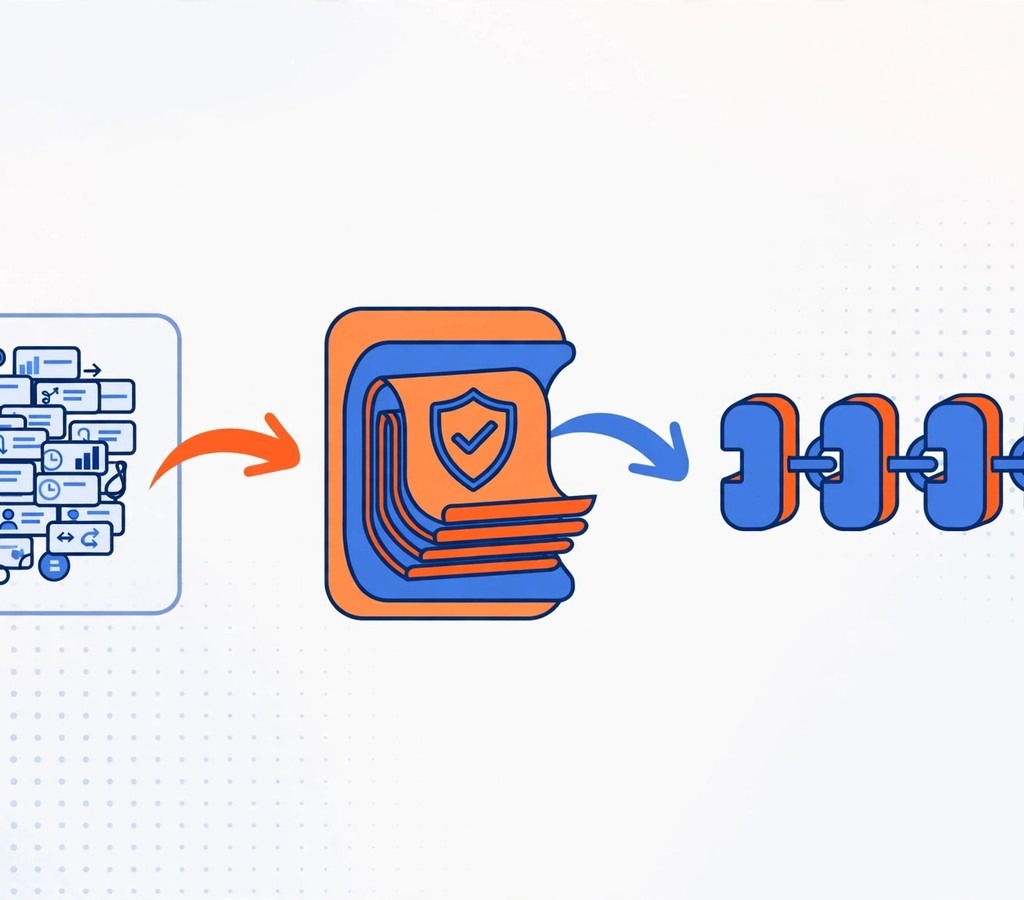
Each block is a batch of entries plus metadata. The metadata includes a timestamp, a reference to the previous block, and a fingerprint of the block’s contents. The fingerprint is a hash: a fixed-length string produced by a one-way function. Feed in any data and you get a hash. Change one character of the data and the hash changes completely. You cannot reverse a hash to recover the original data. That one-way property is what makes tampering detectable.
How Blocks Link Together
Block N contains the hash of block N-1. Block N+1 contains the hash of block N. The result is a chain of fingerprints. To alter a transaction in block 100, an attacker must recompute the hash of block 100, then block 101, then block 102, and so on — and convince the network to accept the rewritten chain over the original. On a large network, that means redoing an enormous amount of work faster than the honest network keeps adding new blocks. That is the security model in one paragraph. It is probabilistic, not absolute. Security grows with each new block added on top.
2. Hashing and Merkle Trees
Hashing is the most-used primitive in blockchain. Bitcoin uses SHA-256. Ethereum uses Keccak-256. Both produce a fixed-size output from any input, and both are designed so that finding two different inputs with the same output is practically impossible. A hash is not encryption. Nothing is hidden by hashing alone. A hash is a fingerprint: it proves that data has not changed, without revealing the data itself.
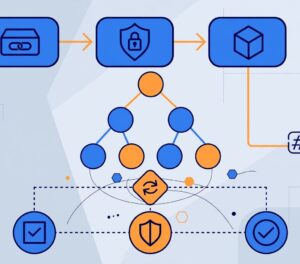
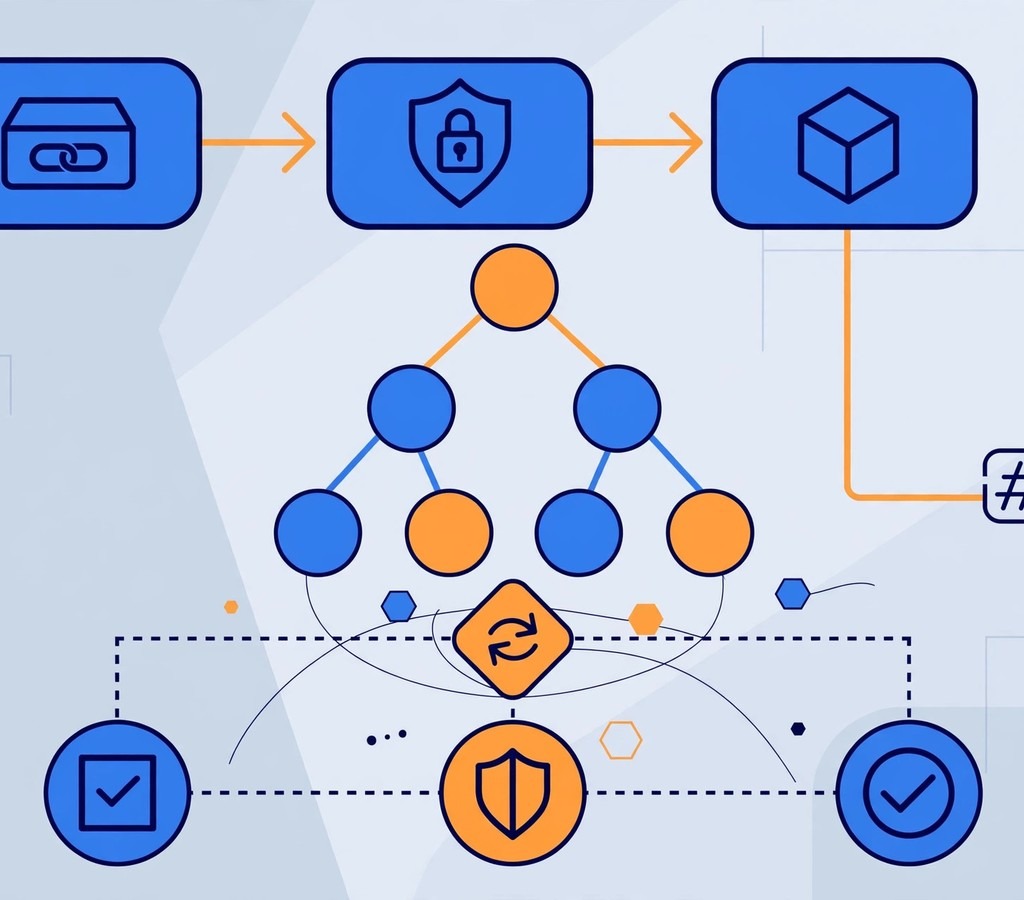
A block can hold thousands of transactions. Storing and checking every one, every time, would be slow. The solution is a Merkle tree. Transactions are hashed in pairs, then those hashes are hashed in pairs, and so on, until one hash remains: the Merkle root. The root sits in the block header. To prove that one transaction is in a block, you only need a short path of hashes — a Merkle proof — not the whole block. Light clients use this to verify a payment without downloading gigabytes of data.
| Concept | What it does | Why it matters |
|---|---|---|
| Hash function | Turns any data into a fixed fingerprint | Detects any change, however small |
| Merkle tree | Compresses many transactions into one root hash | Fast verification without full data |
| Digital signature | Proves the sender authorised a transaction | Stops others spending your funds |
| Public key | Your shareable address identity | Others can verify, not spend |
| Private key | Your secret signing key | Whoever holds it controls the funds |
3. Digital Signatures: How Ownership Works
Every blockchain account is a pair of keys. The public key becomes your address. Anyone can see it. The private key is secret. Only it can sign a transaction from that address. When you send coins, your wallet signs the transaction with your private key. Every node can check the signature against your public key and confirm you authorised the spend — without ever seeing your private key.
This is why the phrase “not your keys, not your coins” matters. An exchange holds your keys when your coins sit on it. You hold an IOU, not the coins themselves. The Binance proof-of-reserves episode in 2026 showed why that distinction is practical, not philosophical: when withdrawals pause, the holder of the keys decides when you get your money back. Our blockchain wallet guide explains how to hold your own keys safely.
4. Nodes: Who Actually Runs a Blockchain?
A node is a computer running blockchain software. Nodes fall into types, and the type matters for security and trust.
- Full nodes download and verify every block and every transaction from the beginning. They enforce the rules. If a block breaks the rules, a full node rejects it, even if a miner produced it.
- Light nodes download only block headers and rely on full nodes for transaction data, using Merkle proofs to check what they receive. They are fast and cheap, but they trust others for completeness.
- Archive nodes keep the full history of every state, not just the current balances. Developers and block explorers use them. They need far more storage.
- Miners and validators propose new blocks. In proof of work they are miners; in proof of stake they are validators. They do not set the rules — full nodes do. A miner who breaks the rules produces a block the network rejects, and earns nothing.
Decentralisation is really a count of independent full nodes and of who controls block production. A chain with 10,000 full nodes spread across many countries is harder to censor than a chain with 20 validators run by one company. Always ask for the node count and the distribution before you believe a “decentralised” claim.
5. Consensus in Depth: Proof of Work vs Proof of Stake
Proof of Work
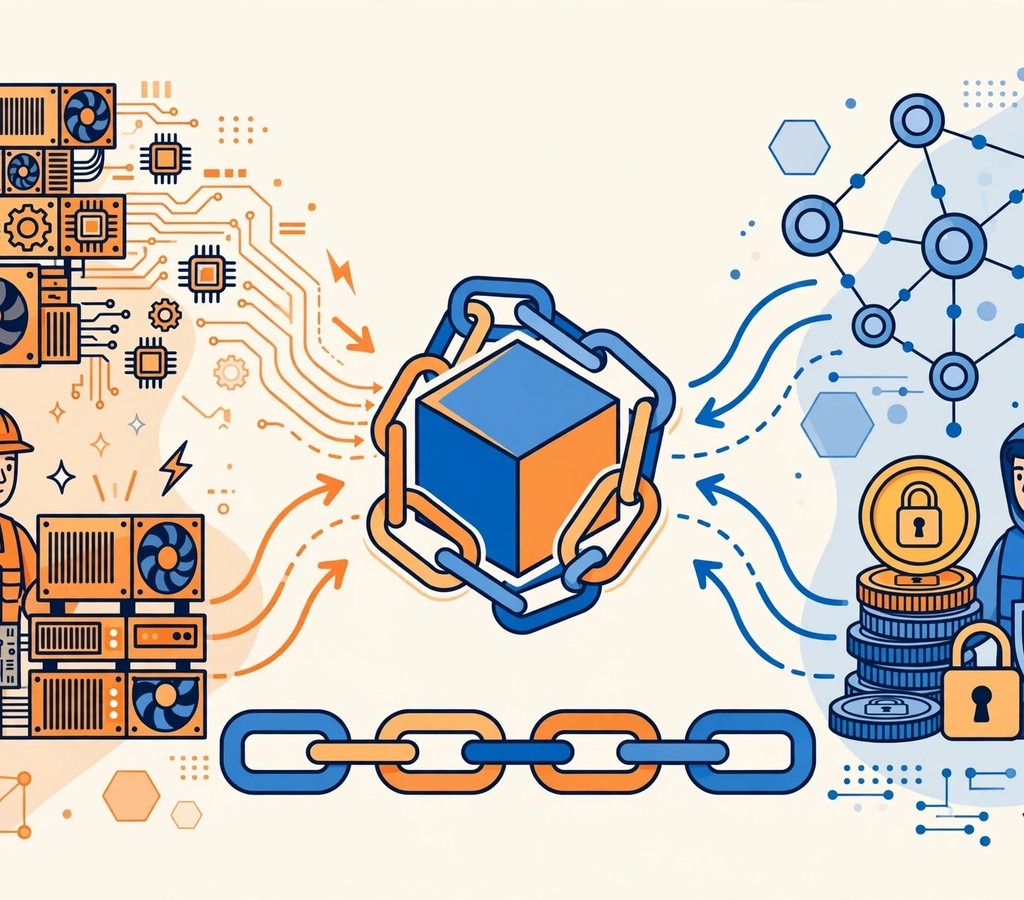
In proof of work, miners compete to find a nonce — a number that, when hashed with the block data, produces a hash below a target value. The target adjusts so blocks arrive on schedule: about every ten minutes for Bitcoin. The first miner to find a valid nonce broadcasts the block. Other nodes verify it cheaply and add it to their copy. The winner receives the block reward plus transaction fees.
The security argument is economic. Attacking the chain requires controlling more computing power than the honest network, and sustaining that control while the network keeps growing. The cost is electricity and hardware, paid in the real world. The weakness is also economic: mining concentrates where power is cheap, and the energy bill is real. Our blockchain mining guide covers the hardware, pools, and reward maths in detail.
Proof of Stake
In proof of stake, validators lock coins as a stake. The protocol picks a validator to propose the next block, and a committee of others to attest to it. Validators earn fees and rewards for honest work. If they sign two conflicting blocks or go offline, part of their stake is destroyed — a penalty called slashing. Ethereum moved to proof of stake in 2022. Cardano and Solana use variations of the same idea.
Proof of stake uses a fraction of the energy of proof of work. Its risks are different: large holders gain more influence, staking can concentrate in a few pools or exchanges, and the “nothing at stake” problem — where voting on multiple chains costs nothing — must be solved by slashing rules. Neither system is perfect. Both are answers to the same question: how do you make lying expensive?
| Dimension | Proof of work | Proof of stake |
|---|---|---|
| Security cost | Electricity and hardware | Locked capital at risk |
| Energy use | High | Very low |
| Attack threshold | 51% of hash power | Large share of staked supply |
| Finality | Probabilistic, grows with confirmations | Can be explicit after checkpoints |
| Centralisation pressure | Cheap power, mining pools | Wealth, staking pools, exchanges |
| Main example | Bitcoin | Ethereum |
Other Consensus Models
Smaller chains use other methods: delegated proof of stake (token holders vote for a small set of validators), proof of authority (known, vetted validators), and Byzantine fault tolerance variants (used in permissioned chains). These are faster, but they trade decentralisation for speed. When a chain claims thousands of transactions per second, check how many validators it has and who runs them. The answer usually explains the speed.
6. Smart Contracts and the Ethereum Virtual Machine
A smart contract is code stored on a blockchain that runs when called. On Ethereum, contracts run in the Ethereum Virtual Machine (EVM) — a virtual computer that every node runs identically. Because every node runs the same code on the same data, they all reach the same result. That determinism is the point. A contract cannot behave differently on your node than on mine.
Contracts are written in languages like Solidity and compiled to bytecode. Every step costs gas, paid in ETH, which stops infinite loops and spam. The catch is permanence: once deployed, a contract’s code cannot be changed unless the author built in an upgrade path — and upgrade paths are themselves a trust risk. A bug in a contract is public, permanent, and often worth millions to an attacker. That is why audits matter and why even audited contracts get hacked. Our EVM meaning guide explains the virtual machine, gas, and EVM-compatible chains in plain language.
7. Tokens and Standards
Coins are native to a chain. Tokens are built on a chain using a standard. On Ethereum, ERC-20 is the standard for fungible tokens (every unit identical, like money), and ERC-721 is the standard for non-fungible tokens (each unit unique, like a deed). Stablecoins such as USDT and USDC are ERC-20 tokens whose value is pegged to the dollar. The standard is what makes tokens work across wallets and exchanges: any tool that speaks ERC-20 can hold any ERC-20 token.
This is also where most scams live. Anyone can deploy a token in minutes, give it a familiar name, and list it on a decentralised exchange. The contract is the truth, not the name. Check the contract address on an explorer, check the supply and the holders, and check whether the creator can mint more tokens or freeze your balance. If those checks are too much work, you are not ready to buy that token.
8. Layers, Scaling, and the Trilemma
The blockchain trilemma says a chain can optimise for two of three properties — decentralisation, security, and scalability — but not all three at once. Bitcoin chooses decentralisation and security, and accepts slow throughput. A fast chain with 20 validators chooses scalability and security, and gives up decentralisation. There is no design that escapes the trade-off; there are only different choices about where to pay.
| Scaling approach | How it works | Trade-off |
|---|---|---|
| Layer 2 rollups | Bundle many transactions off-chain, post one proof on-chain | Complexity, bridge risk |
| Sidechains | Separate chain with its own validators, bridged to main chain | Weaker security than main chain |
| Sharding | Split the network into parallel pieces | Complexity, cross-shard coordination |
| Larger blocks | Fit more transactions per block | Harder to run a full node |
| Faster block times | Produce blocks more often | More orphaned blocks, more centralisation |
Layer 2 networks such as Arbitrum and Optimism are the most-used scaling route on Ethereum today. They execute transactions off the main chain and post a compressed proof back to it. Optimistic rollups assume transactions are valid unless someone challenges them. Zero-knowledge rollups post a cryptographic proof that the transactions are valid. Both rely on a bridge to move assets between layers — and bridges have been the single most-hacked part of crypto, with billions lost. Scaling the chain is easy. Securing the bridge is hard.
9. Privacy, Transparency, and What Blockchains Cannot Do
Public blockchains are transparent by design. Every transaction is visible forever. Addresses are pseudonymous, not anonymous: an address has no name attached, but once an address is linked to a person — through an exchange, a payment, or a leak — their whole history is visible. Privacy coins such as Zcash and Monero use cryptography to hide amounts, senders, or receivers. Zcash uses zero-knowledge proofs so a transaction can be verified without revealing its details. The Zcash NU7 upgrade in November 2026, which cut block times from 75 to 25 seconds, shows how even privacy chains keep evolving.
Blockchains also cannot fix bad input. If a sensor reports a fake temperature, the chain will faithfully record a lie. This is the oracle problem: a blockchain knows only what is fed into it. Oracles such as Chainlink feed outside data — prices, weather, scores — into contracts. The oracle becomes the trusted part. A contract is only as honest as its oracle, and oracle manipulation has caused major DeFi losses.
Case Studies: When the Details Decided the Outcome
Case Study 1: The 51% Attack That Cost $18 Million
Problem: In 2018–2020, smaller proof-of-work chains such as Ethereum Classic suffered 51% attacks: an attacker rented enough hash power to rewrite recent blocks and double-spend coins. Strategy: Exchanges responded by raising confirmation requirements — waiting for many more blocks before crediting deposits. Execution: Deposit times on affected chains rose from minutes to days. Results: Double-spends stopped, but the chains became slow to use. Lesson: Proof-of-work security scales with network size. Small chains with the same design as Bitcoin are not equally secure.
Case Study 2: The DAO Hack and the Ethereum Fork
Problem: In 2016, a bug in The DAO smart contract let an attacker drain about $60 million of ETH. The code had done exactly what it said — which was not what anyone meant. Strategy: The community debated a hard fork to reverse the theft. Execution: Most nodes adopted the fork; a minority refused, and their chain became Ethereum Classic. Results: Funds were returned on the main chain, but the split proved that “code is law” ends where the community disagrees. Lesson: Immutability is a social choice as much as a technical one.
Case Study 3: The Bridge Hack That Broke the Scaling Story
Problem: In 2022, the Ronin bridge was hacked for about $625 million after attackers compromised five of nine validator keys. Strategy: The bridge had trusted a small validator set with no real decentralisation. Execution: The attackers approved fake withdrawals and drained the funds. Results: The chain halted, funds were partly recovered, and the bridge was rebuilt with stricter rules. Lesson: A chain is only as secure as its weakest bridge. Scaling solutions inherit the security of their connectors.
Case Study 4: The Exchange That Proved Its Reserves
Problem: After the October 2026 security incident, Binance users wanted proof that their funds were backed. Strategy: Binance took a new proof-of-reserves snapshot covering 44 tokens and began generating a zero-knowledge proof, expected to take 50–60 hours. Execution: The snapshot was published on its proof-of-reserves page, and withdrawals reopened in phased batches. Results: About 98% of affected assets were replenished from Binance’s own funds. Lesson: A Merkle-tree proof lets users verify their own balance is included without revealing anyone else’s. It proves backing at one moment — not future solvency, and not an audit of the whole business.
Tools and Resources for Going Deeper
| Tool | What it does | Pros | Cons | Pricing | Best for |
|---|---|---|---|---|---|
| Etherscan | Ethereum explorer and contract reader | Deep detail, verified contracts | Steep learning curve | Free | Reading contracts |
| Blockchair | Multi-chain explorer and API | Many chains, clean API | Less depth per chain | Free tier | Cross-chain checks |
| Glassnode | On-chain analytics | Professional metrics | Paid tiers are costly | Free / paid | Market analysis |
| CryptoQuant | Exchange flows and on-chain data | Strong flow data | Needs interpretation | Free / paid | Flow tracking |
| Dune Analytics | Community SQL dashboards | Custom queries | Requires SQL | Free / paid | Deep research |
| CertiK | Smart contract audits | Known auditor | Audit is not a guarantee | Paid | Checking audits |
| Trail of Bits | Security audits and research | High reputation | Expensive, slow | Paid | Serious projects |
| Chainlink | Decentralised oracle network | Widely used | Oracle risk remains | Usage-based | Price feeds |
| MetaMask | Wallet and dApp browser | Universal support | Hot wallet risk | Free | Interacting with contracts |
| Ledger | Hardware wallet | Keys stay offline | Costs money | From ~$79 | Secure signing |
| Alchemy | Node infrastructure and APIs | Reliable, fast | Centralised dependency | Free tier | Developers |
| Infura | Node access API | Easy to start | Centralised dependency | Free tier | Developers |
Common Misconceptions, Corrected
- “Blockchain is unhackable.” False. The chain itself is hard to rewrite, but wallets, bridges, contracts, and exchanges are hacked regularly. Security is a property of the whole system, not one layer.
- “Decentralised means no one is in charge.” Misleading. Developers, miners, validators, and exchanges all hold power. The question is how that power is spread and checked.
- “More transactions per second is always better.” False. Speed usually costs decentralisation or security. A chain that is fast because five companies run it is a database with extra steps.
- “A proof of reserves is an audit.” False. It proves that listed assets were backed at one snapshot time. It does not cover liabilities, debts, or off-balance-sheet risk.
- “Smart contracts are smart.” No. They are literal. They do exactly what the code says, including the bugs. That literalness is both their strength and their danger.
Frequently Asked Questions
1. How does blockchain technology actually work in detail?
Transactions are grouped into blocks, hashed and linked to the previous block, then verified by nodes and added by consensus. Cryptography makes old blocks tamper-evident, and replication makes the record shared.
2. What is a Merkle tree in blockchain?
A tree of hashes that compresses many transactions into a single root hash in the block header, so one transaction can be verified with a short proof instead of the whole block.
3. What is the difference between proof of work and proof of stake?
Proof of work secures the chain with computing power and energy; proof of stake secures it with locked coins that can be slashed for cheating. Bitcoin uses the first, Ethereum the second.
4. What is a full node, and why does it matter?
A full node downloads and verifies every block and enforces the rules. It is the part of the network that can say no to an invalid block, even one produced by a powerful miner.
5. What is the blockchain trilemma?
The idea that a chain can optimise for two of decentralisation, security, and scalability at once, but not all three. Every design chooses where to compromise.
6. What is a Layer 2 network?
A network built on top of a main chain that processes transactions off-chain and posts a proof back to the main chain, trading some complexity and bridge risk for speed and lower fees.
7. Are smart contracts really unstoppable?
Mostly, once deployed without an upgrade path. That permanence is why bugs are so costly, and why audits, testing, and bug bounties matter before deployment.
8. How private is a public blockchain?
Not very. Transactions are public forever, and addresses are pseudonymous. Once an address is linked to a person, their history is visible. Privacy coins and zero-knowledge proofs address this, with their own trade-offs.
9. What is the oracle problem?
A blockchain cannot see the outside world. It relies on oracles to feed in prices, weather, and other data. If the oracle is wrong or manipulated, the contract acts on wrong data.
10. Do I need to run a node to use a blockchain?
No. Most users rely on wallets and exchanges that connect to other people’s nodes. Running your own full node gives you the strongest verification, but it needs storage, bandwidth, and patience.
For the market context behind these mechanics, see our Bitcoin November outlook, our Ethereum November analysis, our Galaxy bear market accumulation case, our Bitcoin options expiry explainer, and our crypto exchange guide. The primary sources are the Bitcoin white paper, the Ethereum white paper, and NIST blockchain technology overview.
Conclusion
Blockchain technology is not one invention. It is a stack: hashing that fingerprints data, Merkle trees that compress it, signatures that prove ownership, consensus that picks the next block, nodes that enforce the rules, and — on some chains — a virtual machine that runs programs. Each layer solves one problem and creates a new trade-off. The chains that survive are the ones whose trade-offs match their purpose: Bitcoin for hard, slow money; Ethereum for programmable agreements; privacy chains for confidential transfers.
The practical test for any blockchain claim is always the same. Ask who runs the nodes, who proposes the blocks, what it costs to cheat, and what happens when something breaks. If the answers are vague, the technology is not the problem — the marketing is. Read our blockchain wallet guide next to learn how ordinary users hold keys and sign transactions on the networks described here.
Which trade-off would you accept for a system you had to trust with your own money: slower and more decentralised, or faster and run by a few known parties — and what would change your answer?