

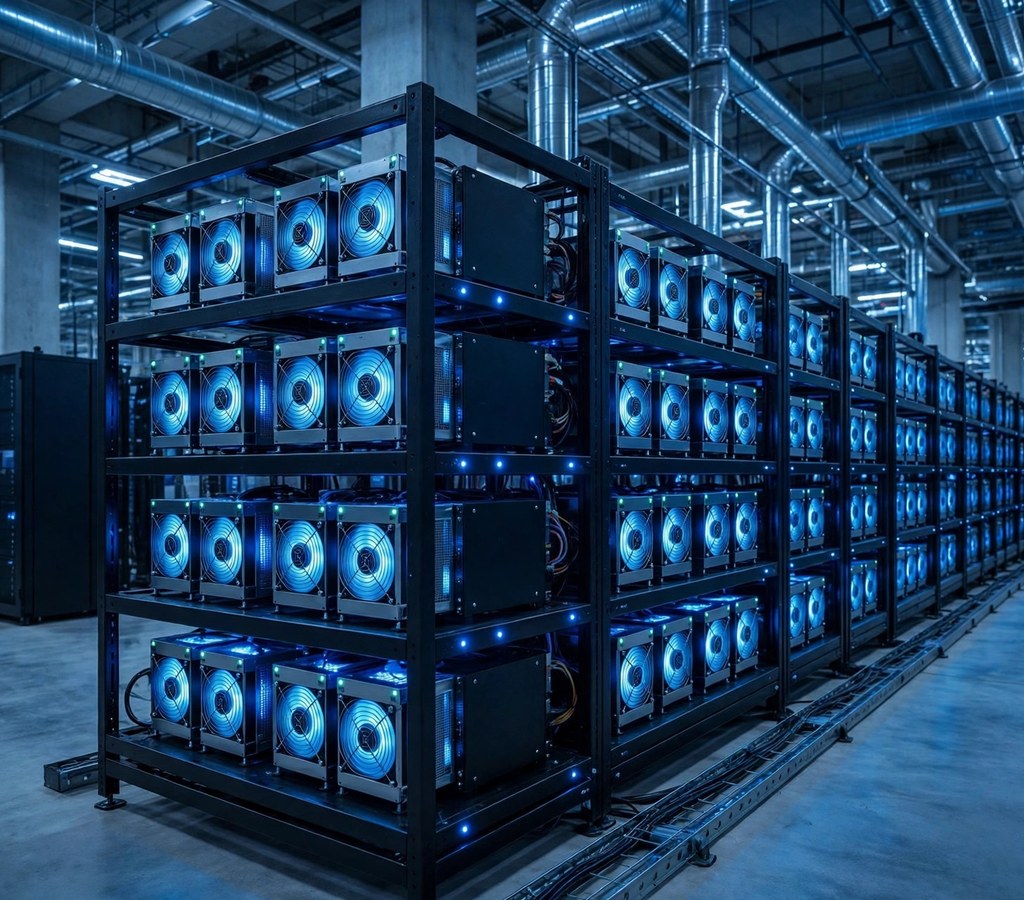
On a freezing night in Iceland, a warehouse hums like a jet engine that never lands. Rows of metal boxes flash green lights. Nobody inside touches a pickaxe or digs any dirt. Yet everyone calls this place a mine.
Maybe a friend mentioned a garage mining rig, or a headline said Bitcoin uses more power than a small country. You want a straight answer: what is blockchain mining, and why does it pay people in crypto?
The short answer surprises most people. Mining is not really about creating coins; it is about keeping a shared ledger honest without a bank in the middle. The coins are the prize that pays strangers to do that job fairly. Roughly every ten minutes, the Bitcoin network hands one miner new bitcoin plus thousands of transaction fees — 3.125 BTC per block since April 2024. Thousands of machines race for it, day and night, and the race itself makes the system hard to cheat.
This guide explains blockchain mining in plain English: how proof of work functions, why miners solve hash puzzles, how mining pools split rewards, and why Ethereum abandoned mining entirely — plus the real costs and the energy debate.
Executive Summary
- Blockchain mining is the contest where computers compete to add blocks of transactions to a blockchain and earn rewards for honest work.
- Miners race to solve a hash puzzle; the winner takes the block reward: new coins plus the block’s fees.
- The winning answer proves the miner spent real computing effort — hence proof of work.
- Difficulty adjustment keeps block times steady. Bitcoin retargets difficulty every 2,016 blocks, roughly every two weeks.
- Most small miners join mining pools and share rewards instead of gambling on a rare solo win.
- Modern Bitcoin mining runs on ASIC machines built for one job. GPUs still mine a few smaller coins.
- Mining vs staking is crypto’s big design split; Ethereum switched to staking in 2022.
What Is Blockchain Mining? A Plain-English Definition
So, what is blockchain mining in the simplest terms? It is a contest that runs around the clock: computers called miners bundle recent transactions into a block, race to solve its maths puzzle, and the first to solve it adds the block and collects new coins and fees.
Think of a lottery where tickets cost electricity: each guess is a ticket, and a bigger machine buys more per second. Nobody can fake a winning ticket, and everyone can check it instantly.
Here is the part most guides skip: the puzzle is not the point. The point is trust without a referee. Banks guard one private ledger with staff and law; a public blockchain guards its shared ledger with cost. Rewriting history means outspending every honest miner combined — possible in theory, ruinous in practice. Our guide on what Bitcoin is backed by explains how this gives the coin its value.
How Blockchain Mining Works, Step by Step
People often ask how does blockchain mining work behind the scenes. Follow one transaction through the system and the whole design clicks into place.
- Transactions gather in the mempool. Your transaction waits in a public waiting room, the mempool, until a miner picks it up.
- A miner builds a block template. Mining software packs waiting transactions — usually favouring higher-fee ones — into a candidate block.
- The miner hashes the block header. The machine runs the block’s data through a hash function (Bitcoin uses SHA-256), producing a fixed-length string.
- The miner hunts for a number below the target. The result must fall below a network-wide target, so the miner changes a small field called the nonce and hashes again — billions of times.
- Someone finds a valid hash. The winning machine broadcasts the block. Every other node checks the answer in a split second.
- The network builds on top. Miners abandon their templates and race on the next block; the winner collects the block subsidy plus all fees.
- Confirmations pile up. Each new block makes the payment harder to reverse; six confirmations is a common finality standard for large payments.
Notice what is missing: trust. You never need to know the winning miner — the maths checks their work for free. That is what is mining in blockchain terms: identity replaced by verification.
Proof of work, explained with a dice game
Proof of work means this: to propose a block, you must prove you did costly work. Imagine rolling dice until they show five sixes in a row. Rolling takes effort; verifying the winning roll takes one second. Hash puzzles work the same way — brutally hard to find, trivially easy to check — and bitcoin.org’s how-it-works guide explains the idea from the original project’s perspective.
Why miners cannot simply cheat
Can a miner award themselves extra coins? No. Every node runs the same rulebook, and a block that pays too much, spends coins twice or skips the puzzle gets rejected instantly. Honesty here is not a virtue; it is the only profitable setting. It is also why claims that crypto has “died” miss the machinery — our look at whether crypto is dead, through cycles and adoption data, shows the network kept producing blocks through every panic.
Block Rewards and the Halving: How Miners Get Paid
A winning miner collects two income streams: the block subsidy (brand-new coins created by the protocol) and the transaction fees paid by everyone whose transactions sit in that block. Together, they form the block reward.
Bitcoin’s subsidy shrinks on a fixed schedule called the halving: every 210,000 blocks, roughly four years, it cuts in half. No committee votes on it; the code does it, and every node enforces it, until the schedule ends near 2140 at the 21 million BTC cap.
| Era | Approx. years | Block subsidy | What it meant for miners |
|---|---|---|---|
| Launch era | 2009–2012 | 50 BTC | A laptop could mine meaningful amounts at home |
| First halving | 2012–2016 | 25 BTC | GPU rigs took over; mining left the hobby desk |
| Second halving | 2016–2020 | 12.5 BTC | ASIC farms and cheap power became the real contest |
| Third halving | 2020–2024 | 6.25 BTC | Public mining companies and pools dominated |
| Fourth halving | 2024–2028 | 3.125 BTC | Fees matter more; only efficient operators thrive |
| Fifth halving | Expected around 2028 | 1.5625 BTC | The fee market must carry more of the security budget |
Fees rise and fall with demand for block space: busy periods can add a large bonus over the subsidy, quiet periods very little. Income swings with coin price and demand alike — smart miners think like business owners, not gamblers, as our trading coverage notes.
The Machines: ASICs vs GPUs vs CPUs
Not all mining hardware is equal, and the gap is not small. A normal processor (CPU) mined Bitcoin in the early days; graphics cards (GPUs) then proved far faster at the repetitive maths. Then came ASICs — chips designed to run one hash algorithm and nothing else. An ASIC does not browse the web or play games; it hashes relentlessly and made every earlier device obsolete for Bitcoin.
| Hardware | Typical use today | Strengths | Weaknesses |
|---|---|---|---|
| CPU | A few coins designed to resist special hardware | Already in every computer; no extra cost | Far too slow for Bitcoin or Litecoin |
| GPU | Smaller proof-of-work coins | Flexible; resellable to gamers; mines many algorithms | Weak efficiency next to ASICs; high power per hash |
| ASIC | Bitcoin, Litecoin and Dogecoin at any serious scale | Enormous hash rate per watt; purpose-built | Expensive, loud, hot, and useless for anything else |
Two numbers decide whether a machine makes sense: its hash rate (guesses per second) and its efficiency (watts per unit of hash rate). A fast machine that guzzles power can lose money while a slower, efficient one survives — and electricity is the bill that never stops.

Mining Pools: Why Almost Nobody Mines Solo
Consider this: the network produces roughly 144 blocks a day, and millions of machines chase them. A single home ASIC holds a tiny fraction of the total hash power, so mining alone it might statistically wait years to win one block. The electricity bill arrives every month without fail.
Mining pools fix this lottery problem: thousands of miners combine hash power in one pool, which wins blocks regularly and splits each reward by the work each member contributed, minus a small fee. Income turns from a lottery ticket into something closer to a wage.
How pools pay: FPPS vs PPLNS in plain words
Under PPLNS (pay per last N shares), you get paid when the pool finds blocks, so income follows its luck. Under FPPS (full pay per share), the pool pays a steady rate, block or no block, absorbing the luck risk for a higher fee. Beginners usually prefer steadier schemes; veterans sometimes accept variance for lower fees.
| Payout scheme | How you get paid | Income pattern | Typical pool fee |
|---|---|---|---|
| PPS / FPPS | Fixed rate for each share of work you submit | Steady, predictable | Higher, roughly 2–4% (varies by pool) |
| PPLNS | Share of blocks the pool actually finds | Varies with pool luck | Lower, roughly 0–2% (varies by pool) |
| Solo | You keep the whole block — if you ever find one | Feast or famine | Small fee, but extreme variance |
One risk deserves honesty: pools concentrate power. If a few pools ever controlled most of the hash rate, decentralisation would weaken. In practice, miners can switch pools in minutes, and many do when a pool grows too large or misbehaves. That exit option is a real, if imperfect, check.
Difficulty Adjustment: The Network’s Self-Correcting Thermostat
If Bitcoin’s price doubled, thousands of new machines would switch on and blocks would arrive too fast. If it crashed and miners quit, blocks would crawl. The difficulty adjustment prevents both failures. Every 2,016 blocks, Bitcoin compares how long those blocks actually took against the two-week target. Too fast, and difficulty rises. Too slow, and it falls. The system behaves like a thermostat: it does not care how many furnaces exist, only the temperature.
This is why headlines about miners “leaving” rarely endanger the network: when weak miners switch off, difficulty falls, survivors earn more per machine, and mining rebalances toward the cheapest power and best hardware. During the sharp swings we covered in Bitcoin’s move below $80,000 ahead of the Fed decision, hash rate barely flinched.
The Energy Debate: Waste, or a Buyer of Last Resort?
No part of mining draws more argument than electricity. Bitcoin mining uses a large amount of energy — comparable to a mid-sized country’s consumption, according to estimates on the Cambridge Bitcoin Electricity Consumption Index, run by the Cambridge Centre for Alternative Finance. Critics call this wasteful, especially where power comes from fossil fuels.
Supporters answer with three points: much mining hunts stranded energy (hydro that would spill, gas that would be flared, surplus wind and solar); miners can switch off in seconds during grid emergencies; and the energy is the security budget — attacking Bitcoin means outspending all that honest work.
Who is right? It depends where the mining happens: a farm on flared gas or curtailed hydro tells a different story from one burning coal on a strained grid. Argue about the mix and the emissions, by all means — but understand the function first. That habit runs through all our crypto guides and explainers.
Mining vs Staking: The Big Design Split
Not every blockchain uses mining. The main alternative, proof of stake, has validators lock up coins as a deposit and take turns proposing blocks; misbehave, and the protocol can slash the deposit. Security comes from money at risk inside the system, not energy spent outside it.
Ethereum is the famous example. It launched with mining in 2015, then switched to proof of stake in September 2022 in an upgrade called The Merge. Energy use dropped dramatically — the Ethereum Foundation estimated around 99.95% — and thousands of GPU miners had to find new coins or sell their rigs. The ethereum.org page on The Merge documents the switch in detail.
| Feature | Proof of work (mining) | Proof of stake (staking) |
|---|---|---|
| Who secures the network | Miners with hardware and electricity | Validators with locked-up coins |
| Cost of attacking | Outspending the honest hash power | Buying a huge share of the staked supply |
| Energy use | High by design | Very low |
| Who can join | Anyone with hardware and power | Anyone with the required stake (or a staking service) |
| Main examples | Bitcoin, Litecoin, Dogecoin, Kaspa | Ethereum, Cardano, Solana |
| Main criticism | Energy consumption and hardware waste | Wealth concentration; big holders earn more |
Neither design escapes trade-offs, and honest people disagree about which set is safer. Practically, a coin’s consensus design shapes its costs, risks and politics — which is why we weigh it in the evaluation framework we use for any coin. Mining is only one branch of the crypto investment landscape; many simply buy and hold via our crypto exchange guide.
Which Coins Can You Still Mine?
- Bitcoin (BTC) — the original and largest mining economy — ASIC-only in practice, with crypto’s biggest fee market.
- Litecoin (LTC) — runs the Scrypt algorithm on its own ASICs, with faster blocks than Bitcoin and a similar halving rhythm.
- Dogecoin (DOGE) — the meme coin with a serious twist: merged mining. Miners secure Litecoin and Dogecoin with the same work, collecting rewards from both chains — an arrangement protecting Dogecoin since 2014.
- Kaspa (KAS) — a newer proof-of-work coin with a blockDAG design and far faster blocks than Bitcoin. It began as a GPU coin, though ASICs have since arrived and pushed many small miners out.
What Mining Really Costs: A Beginner’s Evaluation Checklist
Social media loves mining “profit” screenshots. It rarely shows the electricity bill or the broken fan. Mining is a business with thin, shifting margins, and any income figure is a snapshot, not a promise.
| Cost item | What it covers | Why beginners underestimate it |
|---|---|---|
| Hardware | The ASIC or GPU rig itself, plus power supplies | Prices swing with the market; last cycle’s bargain can be a doorstop |
| Electricity | Power drawn 24 hours a day, every day | A machine that never sleeps turns a small rate difference into a huge annual gap |
| Cooling and noise control | Fans, ventilation, sometimes more | ASICs are extremely loud and hot; a home setting needs real modification |
| Pool fees | The pool’s cut of your rewards | Small percentages compound over thousands of blocks |
| Maintenance and downtime | Repairs, cleaning, parts, lost hashing time | A stopped machine earns zero but may still sit on a hosting bill |
| Difficulty and price risk | The moving target behind all the others | Your reward share shrinks as more hash power joins the network |
How to judge a mining setup before spending anything
- Price your electricity honestly. Use your real per-kilowatt-hour rate, taxes and fees included — it decides more than any other number.
- Check efficiency, not just speed. Compare watts per unit of hash rate across machines, not headline speed alone.
- Run a calculator with pessimistic inputs. Estimate income with a tool like WhatToMine, then imagine difficulty higher and the price a third lower. If it only works at today’s prices, it is not a plan.
- Plan the exit before the entry. Hardware resells poorly in bear markets. Know who would buy your machine if you stopped.
- Compare against simply buying the coin. Many beginners find buying BTC directly would have beaten their rig — without the noise. Our guide to crypto trading strategies that actually work covers the alternatives honestly.
Case Studies: Four Mining Scenarios, Honestly Told
The stories below are illustrative scenarios built from patterns our team sees again and again. Names are composites, and figures stay general — real outcomes swing with price, difficulty and power costs.
Case study 1: The garage miner who did the maths second
Problem: A hobbyist bought a used ASIC during a price rally, thrilled by a calculator screenshot. His home electricity rate was high — unchecked.
Strategy: He ran the machine for a month, tracked pool payouts daily, then compared them line by line with his power bill.
Execution: Payouts were real but smaller than the screenshot — difficulty had risen, the price had slipped, and the machine’s heat made his household cooling work harder too.
Results: The rig broke even in good weeks and lost money in bad ones. He resold it while it still had value and put the remaining budget into simply holding Bitcoin.
Lessons: Electricity rate is destiny. A calculator is a photograph, not a forecast, and difficulty never sits still for your convenience.
Case study 2: The pool switcher
Problem: A small miner with two ASICs saw payouts swing wildly on a luck-based scheme, making planning impossible.
Strategy: She moved to a steadier payout scheme, accepting a slightly higher fee for predictability.
Execution: She ran both pools side by side for two weeks, one machine each, comparing actual payouts per unit of hash rate.
Results: Total income was nearly identical, but the steadier scheme removed the scary zero days — and the ten-times-a-day dashboard checking.
Lessons: Payout scheme is a planning choice as much as a fee choice — measure with your own machines before believing any pool.
Case study 3: The solar experiment
Problem: A homeowner’s rooftop solar exported surplus midday power to the grid for very little money, and he wondered if a small GPU rig could use it better.
Strategy: He treated mining as a way to store surplus energy in coin form, running the rig only during surplus hours.
Execution: He mined a smaller GPU-friendly coin, automated the rig to follow solar output, and sold coins periodically through an exchange.
Results: Income was modest — far below full-time mining adverts — but power for those hours cost almost nothing, so the experiment stayed slightly ahead.
Lessons: Mining can make sense for energy that would otherwise be wasted, at small scale, with honest expectations. Scale and power price decide everything.
Case study 4: The merged-mining Litecoin operator
Problem: A semi-professional’s Scrypt ASIC margins compressed after a halving cut the Litecoin subsidy.
Strategy: He confirmed his pool paid the merged Dogecoin rewards his machines already earned, and negotiated cheaper industrial hosting.
Execution: The pool switch took an afternoon; the hosting move a month of quotes and contracts. He also set a hard rule: two straight months where power beats payouts, and machines get sold — not “ridden out”.
Results: Combined Litecoin plus Dogecoin income and the lower power rate restored a workable margin, and the sell rule removed emotion from the worst months.
Lessons: Merged mining is extra revenue many Litecoin miners leave unclaimed. Pre-set exit rules protect you from the sunk-cost trap better than optimism does.
Tools, Pools and Platforms Every Miner Should Know
These are the names you will meet repeatedly. Nothing here is sponsored, and fees change — confirm current terms before committing hardware or money.
1. Bitmain Antminer series
The dominant line of Bitcoin ASICs. Pros: huge model range, deep resale market, universal pool support. Cons: prices swing with the market; warranty service can be slow. Pricing: a few hundred dollars for older units to several thousand for current flagships. Best use: the default choice for serious SHA-256 mining.
2. MicroBT Whatsminer series
Bitmain’s chief ASIC rival. Pros: strong efficiency and a reputation for durability. Cons: smaller repair and resale ecosystem in some regions. Pricing: comparable to equivalent Antminer models. Best use: miners who want a credible alternative supplier.
3. Foundry USA Pool
One of the largest Bitcoin pools, with an institutional focus. Pros: big, stable hash rate share; consistent block finding; transparent reporting. Cons: geared to professionals, with stricter account requirements. Pricing: FPPS-style fees, a small percentage — confirm the current rate. Best use: larger miners who value steady, compliance-friendly payouts.
4. Antpool
A long-established pool linked to Bitmain, supporting several coins. Pros: multiple payout options, mature dashboard. Cons: its size fuels the pool-concentration debate. Pricing: scheme-dependent, generally low single digits. Best use: miners running Bitcoin and Litecoin/Dogecoin hardware together.
5. F2Pool
One of the oldest multi-coin pools, founded in 2013. Pros: supports many mineable coins beyond Bitcoin. Cons: breadth makes the interface try to serve everyone at once. Pricing: per-coin fees, commonly around 2% for PPS-style payouts. Best use: GPU and altcoin miners who switch coins as profitability moves.
6. Braiins Pool (formerly Slush Pool)
The first mining pool ever launched, run by Braiins, which also builds mining firmware. Pros: pioneered transparent scoring; firmware can improve ASIC efficiency. Cons: smaller hash rate share means more payout variance. Pricing: around 2%, partly offsettable via its firmware arrangements. Best use: transparency-focused miners.
7. NiceHash
A hash power marketplace rather than a classic pool: you rent your machine’s power to buyers. Pros: very simple software; paid in Bitcoin whatever your machine mines. Cons: fees stack up, and payouts usually trail direct pool mining slightly. Pricing: a tiered fee of a few percent on earnings. Best use: beginners and GPU owners who want zero pool configuration.
8. WhatToMine
The best-known mining profitability calculator. Pros: covers many coins and hardware profiles, and forces you to enter your power cost — the right habit. Cons: estimates are snapshots; difficulty and price move constantly. Pricing: free. Best use: a first-pass sanity check before buying hardware, never a guarantee.
Common Mistakes, Expert Tips and Troubleshooting
Mistakes that cost beginners the most
- Buying hardware at the top of the cycle. When coins pump, ASIC prices pump harder, and the machine arrives just as difficulty peaks.
- Ignoring the power rate. A few cents per kilowatt-hour quietly decides profit or loss over a year.
- Forgetting heat and noise. One ASIC sounds like a vacuum cleaner that never stops and heats a room like a small oven. Homes need a plan for both.
- Mining into a wallet they do not control. Payouts should land in your own wallet, not sit on an exchange.
- Chasing every new coin. Beginners hop coins daily and pay for it in downtime.
Tips from experienced operators
- Track income per unit of hash rate weekly. It reveals difficulty creep before your gut does.
- Write your sell rules down while calm, as case study 4 showed. Nobody invents good rules mid-panic — the same discipline our Trading section preaches for market positions.
Troubleshooting quick guide
Hash rate dropped overnight? Check temperatures and fan errors first, then the pool’s status page. Payouts below the calculator’s promise? Compare accepted shares and uptime; calculators assume perfection. Machine loud and hot? Clean fans and filters — dust is the silent efficiency thief. Worker offline? Restart the miner and re-check the pool URL and worker name; one typo idles a machine for days.
The Future of Mining
Three threads shape mining’s next decade. First, the fee transition: as the subsidy halves again around 2028 and beyond, fees must fund more of the security budget. Second, energy integration: deals with power producers — flared-gas capture, curtailed renewables, grid balancing — may reframe the debate from “how much” to “which and when”. Third, geography: mining migrates toward cheap, stranded or politically stable power, and policy keeps redrawing that map.
Understanding mining means understanding how the first blockchain defends itself — which is why explainers like this anchor our CryptoOrbitZone homepage coverage.
Frequently Asked Questions
1. What is blockchain mining in simple words?
Computers race to solve a puzzle; the winner adds the next block of transactions to the blockchain and earns new coins plus fees. The race keeps the shared ledger honest without a bank.
2. How do miners actually earn money?
They earn the block reward: newly issued coins plus the transaction fees inside the block they win. Most miners join pools and receive a steady share of pool rewards instead of waiting for a rare solo win.
3. What is proof of work?
A miner must prove costly computation before the network accepts their block. The proof — a valid hash — is hard to produce and instant to verify, making cheating expensive and honesty profitable.
4. Can I mine Bitcoin on my laptop or phone?
The software will run, but practically, no: ASICs are vastly faster, so a laptop earns a negligible fraction while wearing out its hardware. Most phone “mining” apps are advertising schemes, not real mining.
5. What is a mining pool, and do I need one?
A pool combines many miners’ hash power and splits rewards by contributed work. Unless you run a warehouse of machines, yes — a pool turns rare jackpots into smaller, regular payouts for a small fee.
6. Why does Bitcoin mining use so much electricity?
Because electricity is the cost that secures the network: miners spend power to prove work, and an attacker must outspend all of them. The real debate is the energy mix — coal on a strained grid versus stranded hydro or flared gas.
7. What is the Bitcoin halving, and why does it matter to miners?
Every 210,000 blocks, roughly four years, the new-coin part of the reward halves. The April 2024 halving set it to 3.125 BTC. Halvings squeeze high-cost miners and push the industry toward efficiency and fee income.
8. What is the difference between mining and staking?
Mining secures a chain with hardware and energy; staking uses locked-up coins that can be penalised for misbehaviour. Bitcoin mines; Ethereum switched to staking in The Merge in 2022.
9. Which coins can still be mined besides Bitcoin?
Litecoin and Dogecoin are the best known — Dogecoin is merged-mined with Litecoin, so one lot of work earns both. Kaspa is a newer mineable coin with much faster blocks. Most other former mining coins moved to staking.
10. Is mining profitable for beginners?
Sometimes — never by default, and never as a promise. Profit depends on your electricity price, hardware efficiency, the coin’s price and network difficulty. Run pessimistic numbers before spending, and compare against simply buying the coin.
Conclusion
What is blockchain mining? It is an open, ongoing auction for one job: writing the next page of a shared ledger honestly. Proof of work makes lying expensive. Block rewards and halvings pay for the work while controlling new supply. Difficulty adjustment keeps the system steady as miners come and go. Pools turn the lottery into wages, and the energy debate asks what that security should cost the planet.
Your next step depends on your goal. For income, start with your electricity rate and a pessimistic calculator run, then compare the result with simply buying and holding through a trusted platform. For the wider story, follow the analysis in CryptoOrbitZone’s cryptocurrency coverage.
So, one question to close: knowing that mining is really a security service paid in new coins, do you see miners as the network’s accountants, its power plant, or its police force — and which of those jobs would you trust a bank to do cheaper?
This article is educational and is not financial advice. Mining involves real costs and real risk. Do your own research before buying hardware or any crypto asset.