

Introduction
A graphic designer spends six months creating a unique brand identity for a client. A few weeks after launch, she discovers a nearly identical design being used by another company in a different country.
The problem is not unusual.
Creators, inventors, artists, software developers, and businesses lose billions of dollars every year because of intellectual property disputes, piracy, ownership conflicts, and licensing challenges.
Traditional intellectual property systems often move slowly. Registration processes can take months. Cross-border enforcement is difficult. Ownership records may become fragmented across different databases.
This is where blockchain in intellectual property enters the conversation.
Blockchain technology offers a new way to record ownership, verify authenticity, manage licensing agreements, and track intellectual property rights in real time.
According to multiple industry studies, global intellectual property-intensive industries contribute trillions of dollars to economic activity each year. As digital content grows, protecting ownership becomes more challenging and more important.
Many experts now view blockchain in intellectual property management as one of the most promising applications of distributed ledger technology.
This guide explains how blockchain works in intellectual property, where it creates value, where it falls short, and what organizations should know before implementation.
As digital ownership becomes more important, blockchain in intellectual property is emerging as a practical solution for protecting creative and commercial assets.
Executive Summary
Key Takeaways
- Blockchain in intellectual property creates immutable ownership records.
- Smart contracts can automate licensing and royalty payments.
- Blockchain improves transparency and reduces disputes.
- Adoption remains limited by regulation, scalability, and legal recognition.
- Several platforms already support IP registration and digital rights management.
- Businesses can use blockchain to protect copyrights, patents, trademarks, and digital assets.
- Future developments may reshape how creators monetize their work.
This article covers definitions, benefits, limitations, implementation steps, cost considerations, real-world examples, case studies, tool comparisons, industry trends, and future predictions.
What Is Blockchain in Intellectual Property?
Simple Definition
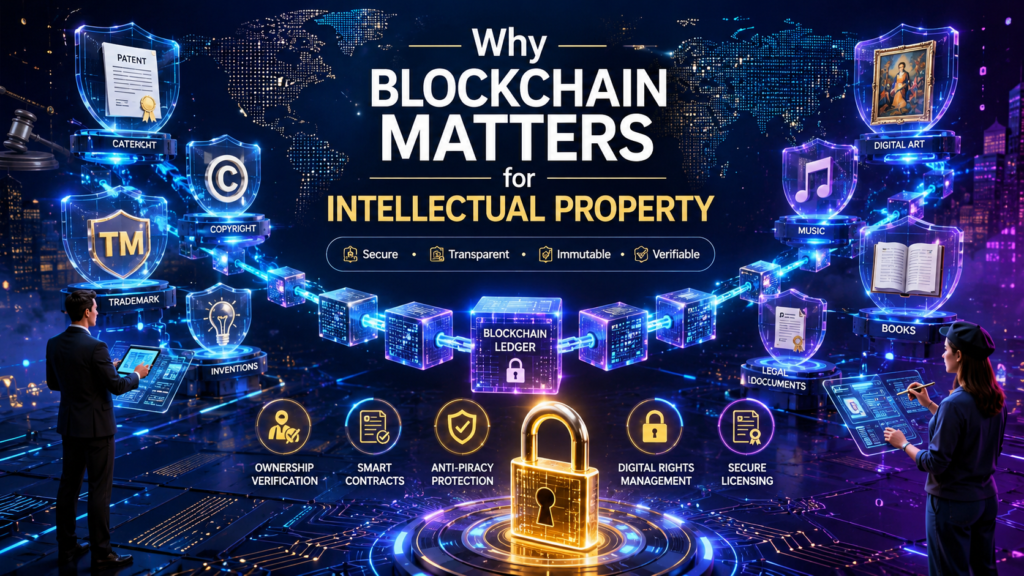
Blockchain in intellectual property refers to the use of blockchain technology to record, verify, manage, protect, and transfer intellectual property rights.
Instead of relying entirely on centralized databases, blockchain stores records across a distributed network.
Each record becomes difficult to alter once validated.
This creates a transparent and traceable history of ownership.

Understanding Intellectual Property
Before exploring blockchain applications, it helps to understand intellectual property itself.
Types of Intellectual Property
| Type | Description |
|---|---|
| Copyright | Protects creative works |
| Patent | Protects inventions |
| Trademark | Protects brand identity |
| Trade Secret | Protects confidential business information |
| Industrial Design | Protects visual design elements |
Every category faces challenges related to ownership verification and enforcement.
How Blockchain Works in Intellectual Property
Recording Ownership
Creators can upload proof of creation.
The blockchain records:
- Timestamp
- Creator identity
- Asset information
- Ownership history
The record remains available for future verification.
Smart Contracts
Smart contracts execute automatically when predefined conditions are met.
For example:
- Music is streamed.
- Usage data is verified.
- Royalty payments are distributed automatically.
This reduces administrative overhead.
Asset Tracking
Blockchain creates a permanent audit trail.
Users can track:
- Ownership transfers
- Licensing agreements
- Usage rights
- Revenue distribution
Why Blockchain Matters for Intellectual Property
Growing Digital Content
Every day, millions of digital assets enter the market.
These include:
- Videos
- Images
- Music
- Software
- Designs
- Research papers
Ownership disputes increase as content grows.
Many legal and technology experts view blockchain in intellectual property as a promising approach to reducing ownership disputes and improving rights management.
Cross-Border Challenges
Traditional enforcement becomes difficult across multiple jurisdictions.
Blockchain offers a globally accessible record system.
Trust and Transparency
Blockchain reduces reliance on a single authority.
Participants can verify records independently.
Benefits of Blockchain in Intellectual Property
Enhanced Ownership Verification
Creators can establish proof of existence quickly.
This helps during disputes.
One reason organizations are exploring blockchain in intellectual property is the ability to verify ownership without relying entirely on centralized databases.
Improved Transparency
All authorized parties can view transaction histories.
This reduces uncertainty.
Faster Licensing
Licensing agreements become easier to manage.
Automation reduces delays.
Reduced Fraud
Tamper-resistant records discourage manipulation.
Automated Royalty Payments
Smart contracts can distribute payments automatically.
Creators receive compensation faster.
Drawbacks of Blockchain in Intellectual Property
Legal Recognition Issues
Not all jurisdictions recognize blockchain records equally.
Scalability Challenges
Large networks may experience performance limitations.
Implementation Costs
Development and integration require investment.
Data Privacy Concerns
Some information should not be publicly visible.
Technical Complexity
Organizations often require specialized expertise.
Blockchain in Copyright Protection
Digital Content Registration
Creators can timestamp original works.
Examples include:
- Books
- Music
- Videos
- Photography
- Digital artwork
Content Verification
Ownership claims become easier to verify.
This can strengthen evidence during disputes.
Blockchain in Patent Management
Patent systems involve extensive documentation.
Blockchain can support:
- Filing records
- Inventor verification
- Licensing history
- Patent transfers
This improves traceability.
Blockchain in Trademark Protection
Counterfeit products remain a global problem.
Blockchain helps by:
- Verifying brand ownership
- Tracking authorized products
- Improving supply chain visibility

Step-by-Step Implementation Process
Step 1: Identify IP Assets
Determine which assets require protection.
Step 2: Select a Blockchain Platform
Choose infrastructure based on business needs.
Step 3: Create Digital Records
Document ownership details carefully.
Step 4: Develop Smart Contracts
Automate licensing and payments where appropriate.
Step 5: Integrate Existing Systems
Connect blockchain records with current workflows.
Step 6: Monitor and Update
Review performance regularly.
Case Study 1: Independent Music Creator
Problem
Royalty payments arrived slowly.
Strategy
Implemented blockchain-based licensing.
Execution
Smart contracts automated distribution.
Results
Payment processing time decreased significantly.
Lesson
Automation improves creator compensation.
Case Study 2: Digital Artist
Problem
Artwork duplication across marketplaces.
Strategy
Registered ownership records on blockchain.
Execution
Timestamped original files.
Results
Ownership verification became simpler.
Lesson
Early registration strengthens protection.
Case Study 3: Software Startup
Problem
Source code ownership disputes.
Strategy
Recorded development milestones.
Execution
Created immutable timestamps.
Results
Improved documentation and auditability.
Lesson
Evidence matters during disputes.
Case Study 4: Manufacturing Company
Problem
Counterfeit product concerns.
Strategy
Blockchain-based tracking system.
Execution
Recorded product authentication data.
Results
Customer trust improved.
Lesson
Transparency supports brand value.
Case Study 5: Publishing Organization
Problem
Complex rights management.
Strategy
Smart contract licensing.
Execution
Automated usage permissions.
Results
Administrative costs declined.
Lesson
Automation scales efficiently.

Blockchain Intellectual Property Tools and Platforms
IBM Blockchain
Pros
- Enterprise support
- Strong infrastructure
Cons
- Higher implementation complexity
Best For
Large organizations
Hyperledger Fabric
Pros
- Permissioned network
- Flexible architecture
Cons
- Technical learning curve
Best For
Enterprise deployments
Ethereum
Pros
- Smart contracts
- Large ecosystem
Cons
- Transaction fees fluctuate
Best For
Decentralized applications
OpenSea
Pros
- Digital asset marketplace
Cons
- NFT market volatility
Best For
Digital creators
IPwe
Pros
- Patent-focused solutions
Cons
- Specialized use case
Best For
Patent management
KODAKOne
Pros
- Image rights focus
Cons
- Limited adoption
Best For
Photography rights
VeChain
Pros
- Supply chain tracking
Cons
- Niche applications
Best For
Brand authentication
Oracle Blockchain
Pros
- Enterprise integration
Cons
- Cost considerations
Best For
Large businesses
ConsenSys
Pros
- Ethereum expertise
Cons
- Enterprise-oriented pricing
Best For
Blockchain development
Alchemy
Pros
- Developer tools
Cons
- Technical focus
Best For
Application development
Tool Comparison Table
| Tool | Best Use Case | Complexity | Enterprise Ready |
|---|---|---|---|
| Ethereum | Smart Contracts | Medium | Yes |
| Hyperledger | Private Networks | High | Yes |
| IBM Blockchain | Enterprise Solutions | High | Yes |
| VeChain | Product Tracking | Medium | Yes |
| IPwe | Patent Management | Medium | Yes |
Cost Analysis
| Expense Category | Estimated Range |
|---|---|
| Development | $5,000–$100,000+ |
| Integration | $2,000–$50,000+ |
| Security Audits | $1,000–$25,000+ |
| Maintenance | Ongoing |
| Training | Variable |
Costs depend on project scope and complexity.
Best Practices
Start Small
Pilot projects reduce risk.
Prioritize Security
Protect wallets and credentials.
Ensure Legal Compliance
Work with qualified legal professionals.
Maintain Accurate Records
Data quality remains critical.
Focus on Business Value
Avoid adopting blockchain without a clear purpose.
Common Mistakes
- Treating blockchain as a complete legal replacement
- Ignoring regulatory requirements
- Underestimating implementation costs
- Failing to educate stakeholders
- Choosing technology before defining objectives
Industry Trends
Experts believe that blockchain in intellectual property will play a larger role as digital content creation continues to expand globally.
AI and Blockchain Integration
Artificial intelligence increasingly supports rights monitoring.
Tokenized Intellectual Property
IP assets may become more liquid through tokenization.
Automated Licensing
Smart contracts continue evolving.
Global Digital Rights Management
Cross-border collaboration is increasing.
Future Predictions
Over the next decade, blockchain may become a standard layer within intellectual property ecosystems.
Potential developments include:
- Real-time royalty payments
- Global ownership registries
- Automated licensing networks
- AI-powered infringement detection
- Improved interoperability between jurisdictions
However, regulation will heavily influence adoption speed.

Pros and Cons Summary
| Pros | Cons |
|---|---|
| Better transparency | Regulatory uncertainty |
| Stronger ownership records | Technical complexity |
| Automated payments | Scalability concerns |
| Reduced fraud | Implementation costs |
| Improved efficiency | Legal recognition varies |
Internal Link Suggestions
- What Is Blockchain
- Smart Contracts Explained
- Digital Rights Management Guide
- Copyright Law Basics
- Patent Management Strategies
- Trademark Protection Methods
- NFT Ownership Explained
- Blockchain Security Best Practices
- Enterprise Blockchain Applications
- Intellectual Property Compliance
- Royalty Management Systems
- Tokenization of Assets
- Blockchain Use Cases
- Decentralized Applications Guide
- Future of Digital Ownership
Authoritative External Resources
- World Intellectual Property Organization
- European Union Intellectual Property Office
- United States Patent and Trademark Office
Frequently Asked Questions
1. What is blockchain in intellectual property?
It is the use of blockchain technology to manage and protect intellectual property rights.
2. Can blockchain replace copyright registration?
Not completely. Legal systems still play a critical role.
3. Is blockchain evidence legally valid?
Recognition varies by jurisdiction.
4. How does blockchain prevent piracy?
It improves ownership verification and traceability.
5. Can patents be stored on blockchain?
Patent-related records can be recorded and tracked.
6. What are smart contracts?
They are self-executing agreements stored on blockchain networks.
7. Is blockchain secure for IP protection?
It can improve security when implemented properly.
8. What industries benefit most?
Media, technology, publishing, manufacturing, and entertainment.
9. How expensive is implementation?
Costs vary widely depending on scope.
10. What is the future of blockchain in intellectual property?
Experts expect increased automation, transparency, and digital rights management capabilities.
Conclusion
Blockchain in intellectual property is not a magic solution, but it offers meaningful improvements for ownership verification, licensing, transparency, and rights management. Organizations that understand both its strengths and limitations can use it to reduce disputes, improve efficiency, and create new revenue opportunities.
The future of blockchain in intellectual property will depend on technological innovation, legal adoption, and industry-wide collaboration.
The technology continues to evolve alongside legal frameworks and digital business models. While challenges remain, the direction is clear: intellectual property management is becoming more digital, more automated, and more transparent.
As creators and businesses seek stronger protection in an increasingly connected world, one question remains: how will intellectual property systems adapt when ownership can be verified globally in seconds?