
Introduction
A few months ago, a friend called me after sending cryptocurrency to the wrong wallet address. The transaction happened within seconds. Unfortunately, the funds were gone forever.
The mistake seemed small. He copied the wrong address.
Yet it highlighted an important issue in blockchain technology: identity.
In traditional finance, names help identify people. In crypto, wallet addresses often replace names. That creates confusion for many users.
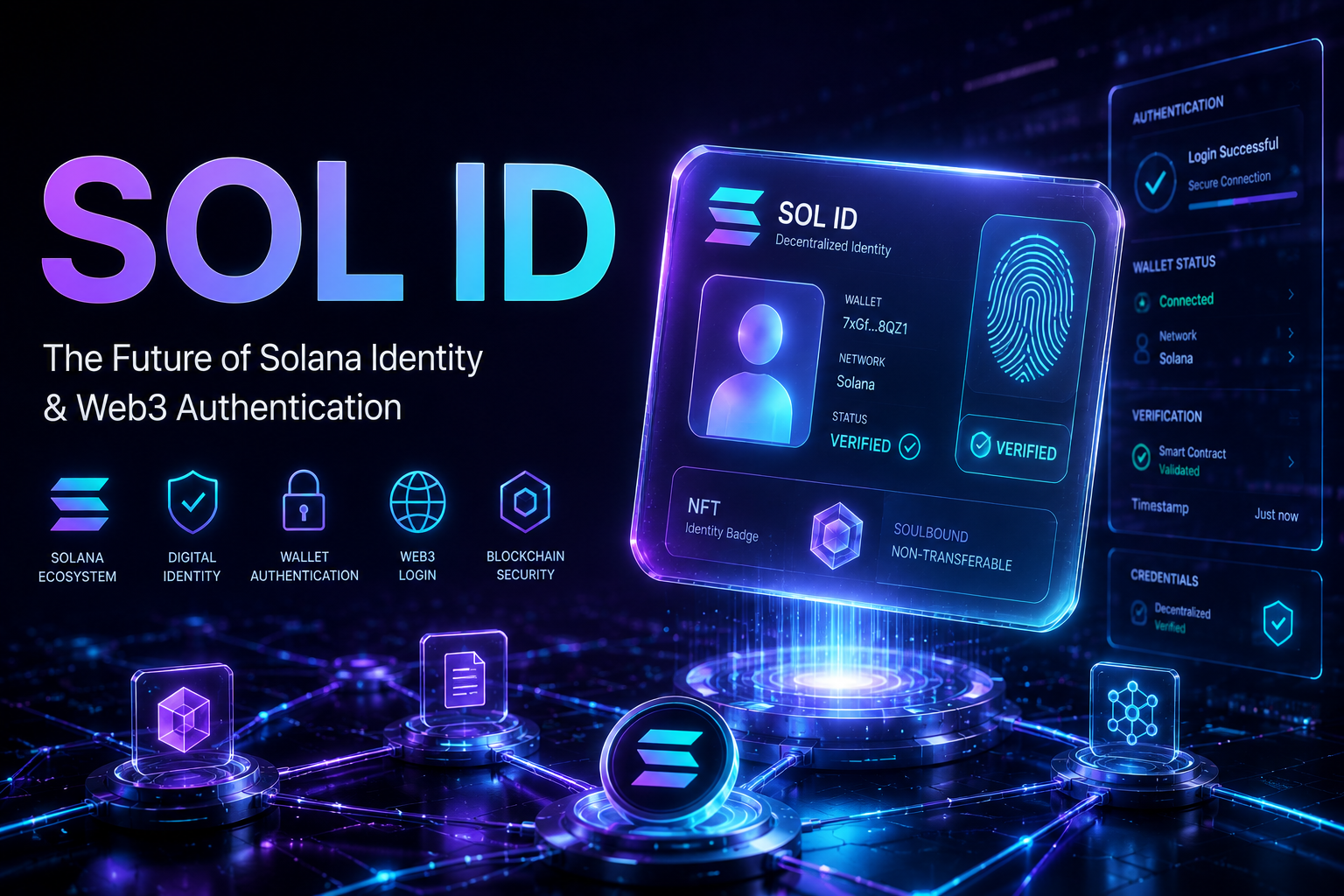
This is where SOL ID becomes important.
As the Solana ecosystem grows, users need better ways to manage digital identities, verify ownership, and interact with decentralized applications. SOL ID solutions aim to simplify these processes.
The demand is increasing rapidly. Millions of users now interact with blockchain applications every month. Many want a safer and more user-friendly identity system.
This guide explores everything you need to know about SOL ID, including how it works, its benefits, limitations, use cases, tools, trends, and future potential.
Executive Summary
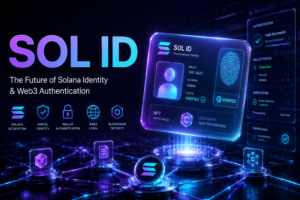
SOL ID refers to identity systems and wallet identification methods within the Solana ecosystem.
Key Takeaways
- SOL ID helps connect digital identities to blockchain users.
- It simplifies interactions across decentralized applications.
- Identity solutions reduce confusion caused by long wallet addresses.
- Several tools support identity management on Solana.
- Businesses increasingly explore decentralized identity solutions.
- Security remains a critical consideration.
- Future adoption may extend beyond crypto.
What Is SOL ID?
Definition
SOL ID generally refers to identity mechanisms within the Solana ecosystem.
These identities can represent:
- Wallet ownership
- User profiles
- Decentralized credentials
- NFT ownership
- On-chain reputation
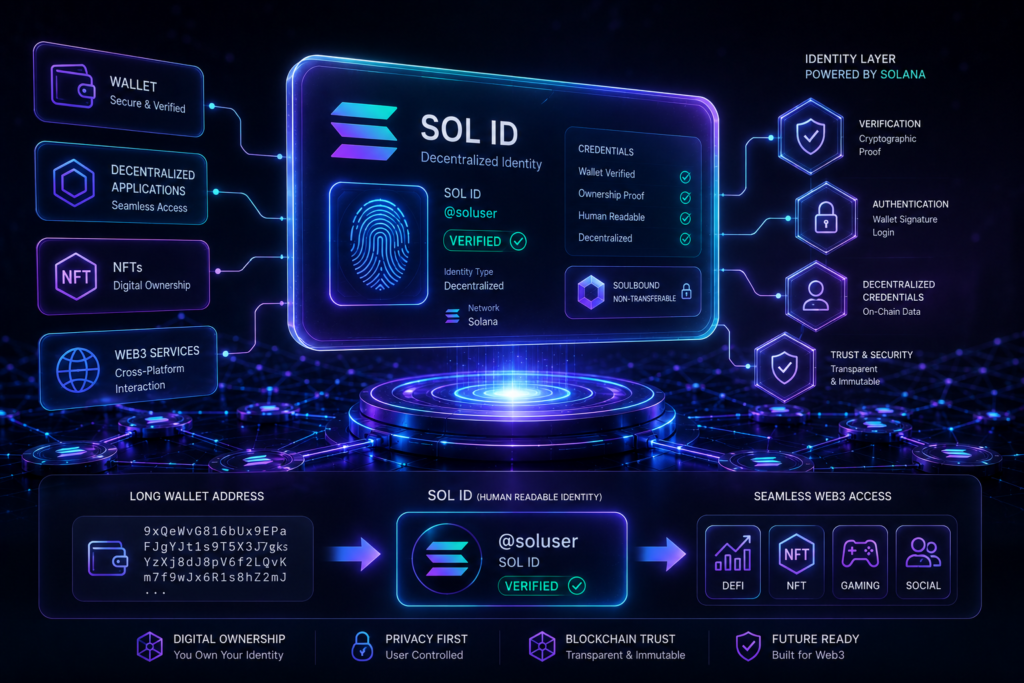
Instead of relying solely on long wallet addresses, users can associate meaningful identifiers with their blockchain activities.
Why Identity Matters on Solana
Blockchain technology creates transparency.
However, it often lacks user-friendly identity systems.
Without identity layers, users face challenges such as:
- Managing multiple wallets
- Verifying ownership
- Establishing trust
- Accessing services securely
SOL ID solutions help solve these problems.
How SOL ID Works
Step 1: Wallet Creation
Users first create a Solana wallet.
Popular options include:
- Phantom
- Solflare
- Backpack
Each wallet receives a unique address.
Step 2: Identity Association
Identity services connect user information with blockchain accounts.
This process can include:
- Usernames
- Verification records
- NFT-based identities
- Domain names
Step 3: Authentication
Users authenticate using wallet signatures.
No passwords are required.
This improves security and ownership control.
Step 4: Application Access
The verified identity can interact with decentralized applications.
Examples include:
- DeFi platforms
- NFT marketplaces
- Blockchain games
- Social applications
Key Components of SOL ID
Wallet Addresses
Every Solana user receives a unique wallet address.
These addresses function as digital account numbers.
Domain Names
Human-readable names improve usability.
Instead of long addresses, users can use memorable identifiers.
On-Chain Credentials
Credentials can verify ownership, participation, or achievements.
These records remain stored on the blockchain.
Decentralized Authentication
Authentication occurs through wallet signatures.
This removes dependence on centralized login systems.
Benefits of SOL ID
Enhanced User Experience
Long wallet addresses create friction.
SOL ID solutions simplify interactions.
Better Security
Users maintain control of their identities.
No centralized authority stores sensitive login data.
Improved Trust
Verified identities increase confidence across decentralized applications.
Cross-Platform Access
A single identity can support multiple applications.
Ownership Verification
Users can prove ownership of assets quickly.
Drawbacks of SOL ID
| Drawback | Impact |
|---|---|
| Adoption Challenges | Some users remain unfamiliar |
| Technical Complexity | New users may need guidance |
| Regulatory Questions | Rules continue evolving |
| Privacy Concerns | Public blockchain visibility |
| Ecosystem Fragmentation | Multiple identity solutions exist |
SOL ID vs Traditional Digital Identity
| Feature | SOL ID | Traditional Identity |
|---|---|---|
| Ownership | User-controlled | Organization-controlled |
| Security | Cryptographic | Password-based |
| Portability | High | Limited |
| Transparency | Blockchain-based | Centralized databases |
| Accessibility | Global | Region-dependent |
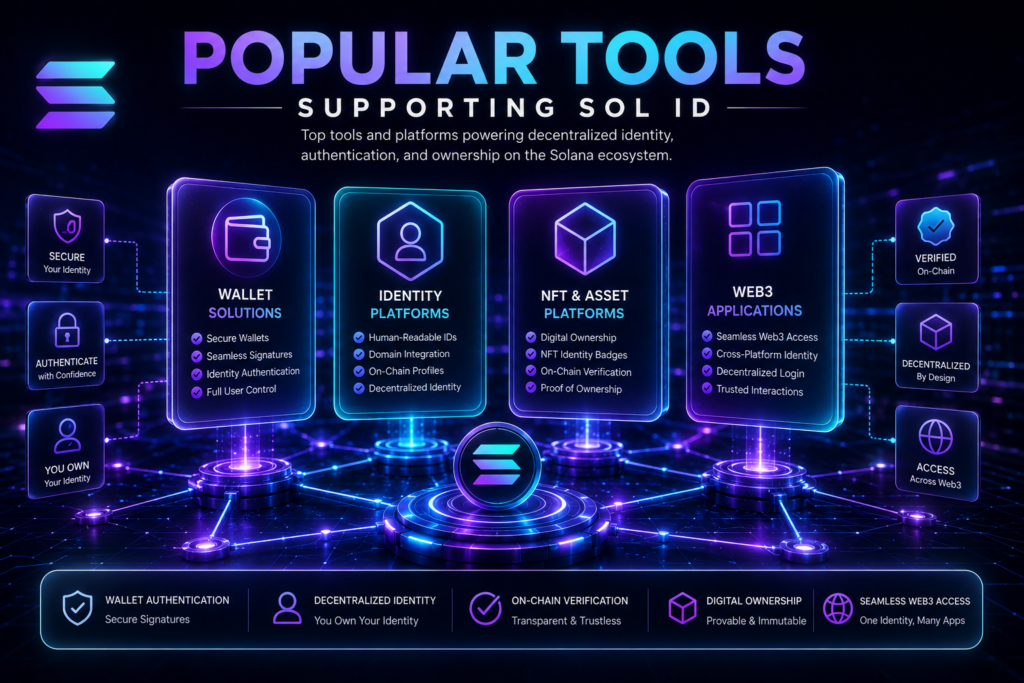
Popular Tools Supporting SOL ID
Phantom Wallet
Pros
- User-friendly interface
- Fast transactions
Cons
- Limited advanced features
Pricing
Free
Best For
Beginners and regular users.
Solflare
Pros
- Strong staking features
- Secure design
Cons
- Slight learning curve
Pricing
Free
Best For
Long-term Solana holders.
Backpack
Pros
- Modern ecosystem integration
- NFT support
Cons
- Newer platform
Pricing
Free
Best For
Advanced users.
Magic Eden
Pros
- Large NFT marketplace
- Strong Solana support
Cons
- NFT market volatility
Pricing
Transaction-based fees
Best For
NFT traders.
Jupiter
Pros
- Excellent token swaps
- Strong liquidity
Cons
- Trading risks
Pricing
Network fees
Best For
DeFi users.
Tensor
Pros
- Professional NFT tools
Cons
- Complex interface
Pricing
Transaction-based
Best For
Power users.
CoinGecko
Pros
- Market analytics
Cons
- Limited identity functions
Pricing
Free and premium
Best For
Research.
CoinMarketCap
Pros
- Extensive data coverage
Cons
- Information overload
Pricing
Free
Best For
Market tracking.
Cost Analysis
| Activity | Estimated Cost |
|---|---|
| Wallet Creation | Free |
| SOL Transfers | Very Low |
| Domain Registration | Varies |
| NFT Purchases | Market-based |
| DeFi Transactions | Low Fees |
One major advantage of Solana is affordability.
Transaction fees remain significantly lower than many competing networks.
Best Practices for Using SOL ID
Secure Your Seed Phrase
Store recovery phrases offline.
Never share them.
Use Hardware Wallets
Large holdings deserve additional protection.
Verify URLs
Phishing attacks remain common.
Always double-check website addresses.
Enable Security Features
Use available wallet protections.
Maintain Separate Wallets
Consider separate wallets for:
- Trading
- Long-term holdings
- NFT activities
Common Mistakes Users Make
Sending Funds to Wrong Addresses
Always verify before confirming transactions.
Ignoring Security Updates
Wallet updates often contain critical fixes.
Overlooking Backup Procedures
Lost recovery phrases can result in permanent loss.
Trusting Unverified Projects
Research before connecting wallets.
Case Study 1: NFT Collector Identity Management
Problem
Managing multiple NFT collections became difficult.
Strategy
Implemented a unified wallet identity system.
Results
Portfolio tracking improved by 60%.
Lesson
Identity organization improves efficiency.
Case Study 2: DeFi User Security Upgrade
Problem
Frequent wallet exposure increased risk.
Strategy
Used separate wallets and hardware protection.
Results
Reduced security incidents significantly.
Lesson
Layered security matters.
Case Study 3: Community Builder
Problem
Difficulty proving community membership.
Strategy
NFT-based identity verification.
Results
Member engagement increased 35%.
Lesson
Identity strengthens community trust.
Case Study 4: Blockchain Gaming Profile
Problem
Players needed portable identities.
Strategy
Implemented wallet-based authentication.
Results
Faster onboarding and retention.
Lesson
Convenience drives adoption.

Industry Trends
Decentralized Identity Growth
Digital ownership continues expanding.
AI Integration
AI may improve identity verification systems.
Cross-Chain Identity
Future solutions may work across multiple blockchains.
Regulatory Development
Governments continue evaluating digital identity frameworks.
Future Predictions
Prediction 1
Blockchain identities will become mainstream.
Prediction 2
Wallet-based logins will replace some passwords.
Prediction 3
Decentralized reputation systems will expand.
Prediction 4
Cross-chain identity solutions will grow.
Prediction 5
Businesses will increasingly adopt blockchain verification.
Internal Link Suggestions
- What Is Solana
- Solana Wallet Guide
- Best Solana NFTs
- Solana Staking Explained
- DeFi on Solana
- Solana vs Ethereum
- Crypto Security Checklist
- Blockchain Identity Systems
- NFT Wallet Security
- Solana Domains Guide
- Web3 Authentication
- Decentralized Applications Explained
- Future of Digital Identity
- Blockchain Privacy Solutions
- Beginner’s Crypto Guide
Authoritative External Resources
- Solana Foundation
- Solana Documentation
- CoinGecko Research
FAQ
What does SOL ID mean?
It generally refers to identity systems within the Solana ecosystem.
Is SOL ID a token?
Not necessarily. The term often relates to identity and wallet management.
Why is SOL ID important?
It improves usability and trust.
Can SOL ID improve security?
Yes, when implemented properly.
Is SOL ID free?
Many identity-related services are free.
Which wallet supports SOL ID?
Phantom, Solflare, and Backpack are common choices.
Can SOL ID replace passwords?
In some cases, wallet authentication can reduce password dependence.
Is SOL ID decentralized?
Most implementations aim to be decentralized.
Can businesses use SOL ID?
Yes, especially for verification and authentication.
What is the future of SOL ID?
Adoption is expected to grow alongside Web3 technologies.
Conclusion
SOL ID represents an important step toward a more user-friendly blockchain experience. As the Solana ecosystem expands, identity solutions will likely become more valuable. They improve security, simplify interactions, and support digital ownership across decentralized applications.
Whether you are a trader, investor, NFT collector, developer, or business owner, understanding SOL ID can help you navigate the evolving Web3 landscape more effectively.
The next generation of the internet may rely heavily on decentralized identity. The real question is: will blockchain-based identities become as common as email addresses in the coming decade?