


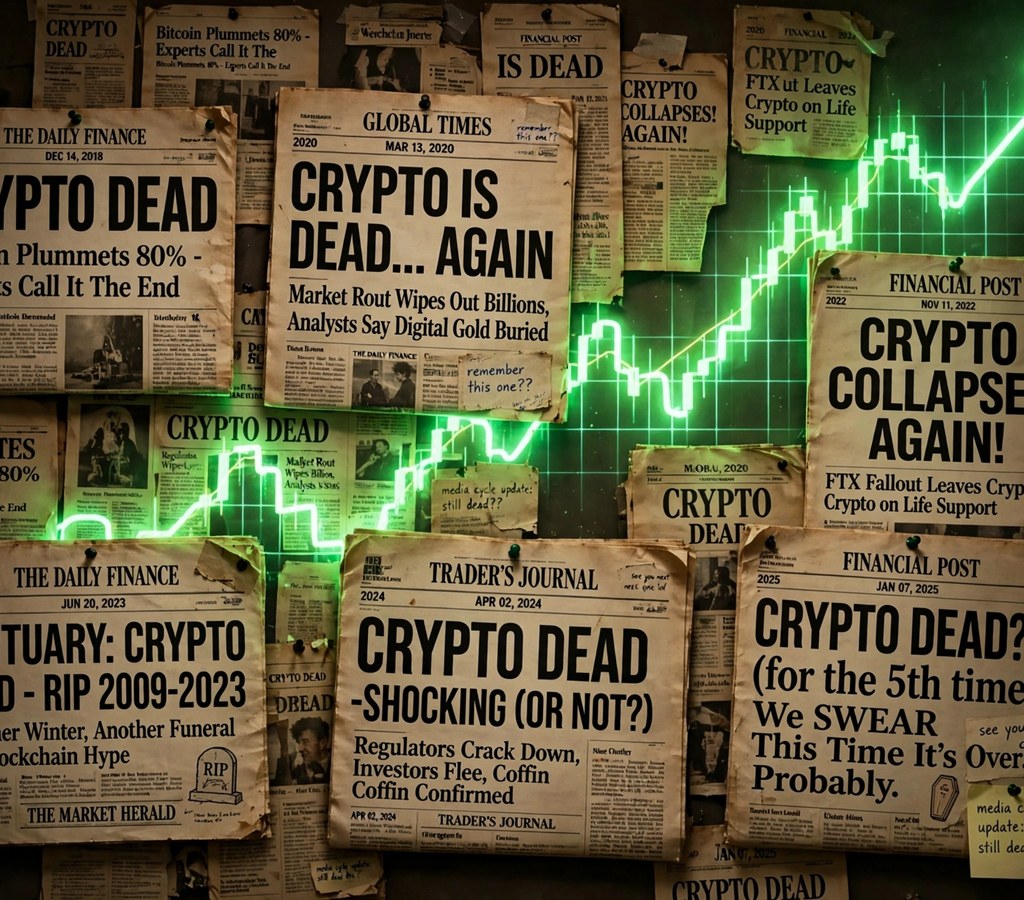
Every few years, the same week seems to repeat itself. Prices slide for months. A big platform fails. Your group chat goes quiet, and then someone sends the screenshot: a major headline announcing that crypto is finished. Again.
Maybe that week is why you are here. You hold some Bitcoin or Ethereum, or you panic-sold in the last crash. Now you face one uncomfortable question: is crypto dead, or is this simply what a brutal cycle feels like from the inside?
Here is the surprising part. Writers have declared Bitcoin dead hundreds of times over the years. Yet the network kept producing blocks, developers kept shipping code, and new users kept arriving. Every obituary so far has been followed by another market cycle.
That does not mean every coin survives; thousands of individual tokens have died. The headline question is too lazy to be useful. This guide replaces it with a better one: how do you judge this market’s health yourself, using evidence instead of fear?
We will walk through the history of the crypto is dead claim, the signals that separate a healthy market from a hype bubble, the tools professionals watch, and the real risks, honestly. Our Bitcoin pullback analysis is a good companion read on sharp pullbacks.
Quick note: this article is education, not financial advice. It cannot tell you what to buy or sell.
Executive Summary
The claim that crypto is dead returns after every crash, and it has been wrong every time so far. Individual projects die constantly, but the core networks, developer activity, and user base have survived every winter. The useful skill is not predicting headlines but reading a small set of health signals: developer activity, real usage, liquidity, leverage, and regulation. Tools like CoinMarketCap, Glassnode, and DeFiLlama make those signals visible for free. Panic selling at headline moments is the costliest mistake ordinary holders make. This article shows you how to check the evidence yourself.
The Short Answer: Is Crypto Dead?
No. Crypto is not dead. The major blockchain networks still operate, developers still build on them, and millions of people use them daily. What dies are individual coins, companies, and hype cycles. Confusing those deaths with the death of the whole market is the core mistake behind most obituaries.
What “Crypto Is Dead” Actually Means
The phrase sounds precise, but it hides three different claims. Separating them is the first step toward judging headlines calmly.
A Price Crash Is Not a Funeral
Most obituaries appear after prices fall hard. But a falling price only proves that sellers outnumber buyers right now. It says nothing about whether the technology works. Bitcoin has survived several deep drawdowns. Each time, the network never stopped: blocks kept arriving roughly every ten minutes, in crashes and rallies alike.
Dead Projects Are Not a Dead Market
Thousands of tokens have gone to zero. Weak ideas, copycat coins, and outright scams fail in every cycle. When a famous token collapses, headlines often treat it as the whole industry dying. In practice, capital and developers usually move to stronger projects. Our guide to evaluating high-growth crypto opportunities explains how to spot weak projects before they fail.
The Company Problem
Sometimes the failure is a company, not a network. Exchanges and lenders can collapse through fraud or reckless risk-taking, as the Bitcoin Depot bankruptcy warning story shows. Those events hurt customers badly, but they do not switch off the underlying blockchains. Keeping these layers separate protects you from bad decisions.
A Brief History of Crypto Obituaries
The Bitcoin obituaries tradition is as old as Bitcoin itself. Dedicated archives track these declarations, and the count runs into the hundreds. The pattern matters more than any single prediction. Obituaries cluster at the bottom of crashes, when fear peaks.
Read the pattern below carefully. It uses only the widely documented shape of past cycles.
| Era | What Critics Said | What Happened Next |
|---|---|---|
| The early years | A fad, a scam, or worthless internet money with no future | The network kept growing, exchanges improved, and a real market formed |
| The post-bubble crash of the late 2010s | The bubble had burst for good and crypto would fade away | A long, quiet winter followed, then building resumed and a new cycle arrived |
| The pandemic-era boom and bust | First unstoppable, then completely finished within two years | Prices cycled violently, but usage, infrastructure, and regulation all expanded |
| The exchange-failure crisis of the early 2020s | Fraud at major platforms proved the whole industry was rotten | Failed firms collapsed, courts and regulators stepped in, and the core networks never stopped |
| Every recent sharp pullback | This time the decline is clearly permanent | Debate continues, which is why guides like our look at whether $100K Bitcoin could come fast exist at all |
The honest lesson is not “crypto always recovers.” Confident death declarations have a terrible track record, because they confuse a price phase with a technology’s survival.
Why the “Crypto Is Dead” Claim Keeps Returning
If the claim keeps failing, why does it keep coming back? Three forces guarantee its return every cycle.
Brutal Cycles Are Part of This Market
Crypto moves in violent cycles of boom, euphoria, crash, and despair. Drawdowns that would be historic in stock markets are routine here. Understanding crypto market cycles does not remove the pain, but it removes the surprise.
Real Failures Feed the Story
Skeptics are not inventing everything. Exchanges have collapsed, founders have committed fraud, and stablecoins have broken. The error is scale: treating one company’s fraud as proof that a global, open network has stopped working. Meanwhile, oversight keeps tightening in major markets, as our coverage of Japan crypto regulation news illustrates.
Headlines Reward Extremes
“Crypto might face a difficult two years” earns few clicks. “Crypto is dead” earns millions. Media incentives favour total statements, and social media amplifies the scariest version, so treat every extreme headline as a marketing product first and evidence second. Following balanced crypto coverage on CryptoOrbitZone helps you see both sides of the story.
Benefits and Drawbacks: The Honest Balance
A balanced answer to is crypto dead requires judging the technology itself, not just its price chart.
The Genuine Benefits
- Open access: anyone with a phone can hold and send value without asking a bank’s permission.
- Fast, global transfers: value moves across borders in minutes, at any hour.
- Programmable money: Ethereum and similar networks run applications, lending markets, and stablecoins automatically.
- Transparency: public blockchains let anyone audit supply and transactions.
- Ownership: self-custody means your assets are not someone else’s liability, as explained in our guide on how to store crypto safely.
The Genuine Drawbacks
- Extreme volatility: prices can fall fast and stay down for years.
- Scams and weak projects: open systems attract fraud, and thousands of tokens are worthless.
- User risk: lose your keys and the money is gone; there is no support desk to call.
- Regulatory uncertainty: rules differ by country and keep changing.
- Uneven real-world use: speculation still dwarfs everyday payments in most places.
Both lists are true at once: the technology offers real utility and real danger, and a market can be risky, immature, and very much alive at the same time. For primary sources, bitcoin.org and ethereum.org explain the core technology in plain language.
Healthy Market vs Hype Market: Signals That Separate Them
When someone asks is cryptocurrency dead, the professional answer starts with signals, not sentiment. A dying market and a quiet, building market look similar in price. They look completely different under the surface.
| Signal | Healthy Market | Hype or Dying Market |
|---|---|---|
| Developer activity | Steady commits, upgrades shipping, active testnets | Silent repositories, abandoned roadmaps |
| User growth | Gradual growth in active addresses and real usage | Spikes driven only by celebrity posts and giveaways |
| Trading volume | Broad volume across major assets and venues | Volume concentrated in a few meme coins |
| Leverage | Moderate borrowing and cautious derivatives use | Extreme leverage and euphoric funding rates |
| New projects | Products gaining real users and revenue | Copy-paste tokens with no working product |
| Media tone | Analytical coverage, including criticism | Only euphoria at tops and total doom at bottoms |
Notice something important: the healthy column often describes quiet bear markets. Boredom is not death.
How to Judge the Claim Yourself: A Step-by-Step Method
You need no finance degree to evaluate a death headline. You need thirty minutes and this sequence.
- Write down the claim. Which asset, network, or company is supposedly dead? Vague claims cannot be tested.
- Check whether the network still runs. Open a block explorer. If blocks and transactions keep flowing, the technology is alive by definition.
- Check developer activity. Look for recent upgrades, active repositories, and shipped products on official channels.
- Check real usage. Review active addresses, transaction counts, and DeFi activity on free dashboards.
- Check liquidity. A living market has deep, broad trading volume. A dying one has empty order books.
- Check the money layer. Stablecoin supply and exchange flows show whether capital is leaving or returning.
- Compare with previous winters. Ask whether today’s signals look worse than past bottoms, or simply familiar. Our walkthrough of using on-chain data for beginners shows where to find each metric.
Best Practices for Reading Market Health
Best Practices
- Review signals monthly, not hourly. Health changes slowly; prices change by the second.
- Use at least three independent data sources before believing any dramatic claim.
- Separate your view of the technology from your view of this month’s price.
- Keep position sizes survivable, so a wrong call never ends your participation. Our guide to crypto portfolio risk management covers sizing rules.
Common Mistakes
- Selling everything on a headline. Headlines peak at maximum fear, which is usually the worst exit point.
- Treating one coin’s death as the market’s death. Most tokens will fail; the market can still thrive.
- Checking only price. Price is the loudest signal and the least informative about survival.
- Trusting a single guru. Confident predictions, bullish or bearish, have poor track records in this market.
Expert Tips
- Watch developer activity during quiet periods. Builders who stay through winters usually define the next cycle.
- Track stablecoin supply like a fuel gauge. Growing supply often precedes returning demand.
- Keep a written “death checklist.” When panic hits, run the checklist instead of your emotions.
- Read primary data yourself before reading opinions. Dashboards first, commentary second.

Case Studies: Four Readers, Four Decisions
The following scenarios are illustrative examples based on patterns seen in every cycle. They show decision processes, not guaranteed outcomes.
Case Study 1: The Panic Seller
Problem: A reader bought near a market top, then watched headlines declare crypto finished during the crash.
Strategy: He sold everything at the point of maximum pessimism to “stop the pain.”
Execution: The sale locked in a heavy loss near the bottom of the cycle.
Results: The market later recovered without him. Re-entering felt impossible, because prices were now far above his exit.
Lessons: Decisions made at peak emotion are usually the most expensive ones. A pre-written plan would have prevented the spiral.
Case Study 2: The Steady Accumulator
Problem: A second reader held through the same crash, despite the same fear and pressure from friends to exit.
Strategy: She committed to small, fixed monthly purchases of major assets only, regardless of headlines.
Execution: She automated the purchases and checked signals quarterly.
Results: Her average entry price blended the top and the bottom, and her position was healthy when the cycle turned, without any perfect timing.
Lessons: A boring, rule-based strategy beat emotional reactions. Surviving the winter was the whole edge.
Case Study 3: The Project Researcher
Problem: A third reader held a popular mid-size token whose community insisted everything was fine during its decline.
Strategy: He ran the step-by-step method above instead of trusting the community’s optimism.
Execution: Developer activity had stalled, liquidity was thinning, and real users were leaving. He exited while a market still existed.
Results: The token later collapsed almost completely. His evidence-based exit protected most of his capital.
Lessons: Individual projects really do die. Checking fundamentals early separates a dying token from a healthy market dip.
Case Study 4: The Checklist Convert
Problem: A fourth reader traded on news alerts, buying tops and selling bottoms in whiplash fashion.
Strategy: She replaced alerts with this article’s signals table, reviewed weekly.
Execution: During the next doom wave, her checklist showed steady developers, stable usage, and modest leverage. She held her plan.
Results: She avoided two panic exits in one year and finally experienced a full cycle calmly.
Lessons: A written framework turns terrifying headlines into routine reviews. Calm is a system, not a personality trait.
The Cost Side: Opportunity Cost and the Price of Panic
Discussions of is bitcoin dead rarely mention what fear itself costs. Yet the biggest losses for ordinary holders often come from reactions, not from the market.
| Approach | Typical Behaviour | Hidden Cost | Better Alternative |
|---|---|---|---|
| Panic selling | Selling everything after doom headlines | Locks in losses near bottoms and misses recoveries | Pre-set exit rules decided in calm times |
| Headline chasing | Buying euphoria, selling despair, repeatedly | Transaction fees, taxes, and consistently bad timing | Scheduled reviews using health signals |
| Total avoidance | Ignoring the market for years after one bad experience | Opportunity cost if the sector matures further | Small, educational positions sized to comfort |
| Overexposure | Investing money needed for rent or emergencies | Forced selling at the worst possible moment | Strict position sizing and an emergency fund first |
The pattern is consistent: behaviour costs more than volatility. Any approach that keeps you from forced, emotional decisions protects capital better than any prediction.
10 Tools That Show Whether Crypto Is Alive
You cannot judge market health from a price app alone. These ten real resources cover price, usage, development, and sentiment. Most are free.
1. CoinMarketCap
The most visited price and market-cap tracker in crypto. Pros: huge coverage, fast overview, free core data. Cons: occasional data disputes and a cluttered interface. Pricing: free; paid API tiers for developers. Best use: a quick health snapshot of the total market.
2. CoinGecko
An independent aggregator known for its exchange trust scores. Pros: transparent methodology and strong coin pages. Cons: limited deep on-chain analytics. Pricing: free; premium plans add features. Best use: comparing coins and checking whether exchange volume looks genuine.
3. Glassnode
A leading on-chain analytics platform for Bitcoin and Ethereum. Pros: deep holder and exchange-flow metrics. Cons: advanced charts need a subscription, and beginners face a learning curve. Pricing: free basic tier; paid tiers unlock the full library. Best use: long-term signals like holder behaviour and exchange balances.
4. DeFiLlama
A transparent dashboard tracking value locked across decentralised finance. Pros: completely free, no ads, open methodology. Cons: covers DeFi only, not the whole market. Pricing: free. Best use: checking whether real users still use on-chain applications.
5. Blockchain.com Explorer and Charts
One of the oldest sources of raw Bitcoin network statistics. Pros: long historical series for hash rate, transactions, and fees. Cons: mainly Bitcoin-focused, with a dated interface. Pricing: free. Best use: verifying that the network itself still runs and grows.
6. TradingView
The standard charting platform used across all markets. Pros: superb charts and cycle overlays. Cons: the free tier limits indicators and alerts. Pricing: free; subscriptions add tools. Best use: seeing price inside full historical cycles instead of scary weekly candles.
7. Crypto Fear and Greed Index
A simple 0-to-100 sentiment gauge published by Alternative.me. Pros: instantly shows emotional extremes. Cons: sentiment alone proves nothing about fundamentals. Pricing: free. Best use: recognising when fear, not data, is driving the conversation.
8. Messari
A research platform offering asset profiles and protocol reports. Pros: high-quality research and standardised disclosures. Cons: the best content sits behind membership. Pricing: free tier; paid membership for full research. Best use: fundamental research before trusting any narrative, bullish or bearish.
9. CryptoQuant
An on-chain platform specialising in exchange inflows and outflows. Pros: clear signals on coins moving toward selling venues. Cons: many metrics need a paid plan. Pricing: free tier; premium plans available. Best use: watching exchange flows during panic periods.
10. 99Bitcoins Bitcoin Obituaries
A long-running archive cataloguing every major “Bitcoin is dead” declaration. Pros: priceless historical perspective, each entry dated and sourced. Cons: Bitcoin only, and it is a reference, not an analytics tool. Pricing: free. Best use: calming down. If the last few hundred obituaries were wrong, demand extra evidence from the latest one.
Regulators publish hype-free investor education too: the SEC’s investor.gov explains crypto risks in sober language.
Troubleshooting: What to Do When Headlines Panic You
Use this short protocol when the next doom wave hits.
- Step away for 24 hours. No crypto decision improves under deadline pressure from a headline.
- Run your death checklist. Network running? Developers active? Liquidity present? If yes, you are watching a cycle, not a funeral.
- Re-read your original plan. If your reasons for holding have not changed, a headline alone is not new information.
- Check sentiment extremes. If fear gauges sit at historic lows, remember that obituaries cluster at bottoms.

Trends and Future Possibilities
Trends Already Visible
Regulation is formalising in major economies. Large financial firms keep building crypto infrastructure. Stablecoins keep expanding as a payment rail. None of this guarantees rising prices. All of it contradicts a simple death story.
Possibilities, Not Promises
Looking forward, several futures are plausible. Crypto could mature into boring financial infrastructure. It could remain a volatile, cyclical niche for another decade. Governments could restrict parts of it heavily in some countries while embracing it in others. A serious technical failure or a superior replacement technology also remains possible. Anyone claiming certainty about which future arrives is selling something.
Frequently Asked Questions
Is crypto dead in 2026?
No. The major networks continue to operate, developers continue to build, and usage continues across trading, payments, and decentralised applications. Operation has never stopped.
How many times has Bitcoin been declared dead?
Hundreds of times over the years. Dedicated archives track these declarations, and the list grows after every crash. So far, every one has been premature.
Is Bitcoin dead?
No. The Bitcoin network keeps producing blocks and processing transactions, through rallies and crashes alike. Its price is volatile; its operation is continuous.
What would actually kill crypto?
A genuine death would need several failures at once: users abandoning the networks, developers leaving permanently, liquidity drying up, and coordinated global prohibition. None of those conditions currently holds.
Why do people keep saying crypto is dead?
Because crashes are dramatic, failures are real, and extreme headlines attract attention. Predicting doom after a collapse rarely looks foolish in the moment, even when it proves wrong later.
Is crypto a good investment right now?
That depends on your finances, timeline, and risk tolerance, and no article can answer it for you. Treat crypto as a high-risk asset class, size any position carefully, and never invest money you need soon.
What is the difference between a bear market and the death of crypto?
A bear market is a long price decline with reduced enthusiasm. Death would mean the networks stop, users vanish, and development ends. Bear markets have happened repeatedly; the second event has not.
Which signals show that crypto is still alive?
Steady developer activity, growing or stable active users, deep trading liquidity, expanding stablecoin supply, and continuing institutional and regulatory engagement.
Should I sell when headlines say crypto is dead?
History suggests headline peaks coincide with maximum fear, which has usually been a poor exit point. Decisions work better when they follow a plan written in calm times, not a reaction written in panic.
Will crypto recover from the next crash?
Every past crash has eventually been followed by recovery at the market level, but past patterns are not promises. Individual coins often never recover. Judge the health signals rather than assuming either outcome.
Conclusion: Judge the Evidence, Not the Headline
So, is crypto dead? The evidence says no. The obituaries have failed hundreds of times, the networks never stopped, and the signals that matter — developers, users, liquidity, and infrastructure — keep pointing to a living, maturing, still-risky market — respect the real dangers, ignore the theatrical ones.
Your next steps are simple. Save the step-by-step method from this article. Pick two or three tools from the list above and check them monthly. Write your plan before the next scary headline arrives, and keep learning through our latest guides on CryptoOrbitZone, including our research on best crypto to buy now and crypto staking rewards explained.
One final thought. The next “crypto is dead” headline is already being drafted somewhere, waiting for the next crash. When it lands in your feed, will you panic like the crowd — or will you be the reader who checks the evidence first?