

Ali bought his first crypto on a lunch break. A friend had sent him a link, the app looked polished, and the “Buy” button took ten seconds to tap. He put in the equivalent of $200 with his debit card and felt proud of himself. Then he checked his balance. He owned noticeably less crypto than he expected.
Nothing had gone wrong with the market. The price had barely moved. What ate his money was the platform itself: a card fee, a wide spread, and a conversion charge he never saw itemized. When he later tried to withdraw his coins, a fourth fee appeared. Ali did not pick a scam. He simply picked a crypto exchange without understanding how exchanges make money.
His story is painfully common. Industry trackers list hundreds of active trading platforms, and their fees, rules, and safety standards vary enormously. Two people can buy the same coin on the same day and end up paying wildly different costs, just because they used different platforms.
Here is the surprising part. The difference between a careless choice and a smart one often costs more than a bad trade does. Fees compound. Security failures are permanent. And most beginners choose their first cryptocurrency exchange based on an advert, not a checklist.
This guide fixes that. You will learn how exchanges actually work, how to compare them honestly, and how to open an account without the usual expensive mistakes. No hype, no shilling, just a clear system you can reuse every time you evaluate a platform.
Executive Summary
A crypto exchange is a marketplace where you trade money for digital assets like Bitcoin and Ethereum, or swap one coin for another. This guide explains the three main platform types, breaks down every common fee, and gives you a security checklist used by experienced traders. You will get a step-by-step account-opening walkthrough, honest reviews of ten major platforms and tools, four practical case studies, and a troubleshooting section for when things go wrong. The core lesson is simple: choose your platform deliberately, verify its safety signals, start small, and move long-term holdings into your own wallet. The cheapest, safest setup usually combines one reputable centralized exchange with self-custody for savings.
What Is a Crypto Exchange?
A crypto exchange is an online marketplace that matches buyers and sellers of digital currencies. You deposit money or crypto, place an order, and the platform pairs your order with someone taking the other side of the trade. Think of it as a currency-exchange desk and a stock market rolled into one app.
Unlike a bank, an exchange does not set the price of Bitcoin. The price emerges from thousands of orders placed by users around the clock. That is why crypto trades 24 hours a day, including weekends and holidays.
How a Crypto Exchange Works Behind the Scenes
Every trade flows through an order book, a live list of buy and sell offers. When your buy order matches a sell order at an agreed price, the exchange executes the trade and updates both balances. The platform charges a small fee for this matching service.
Most beginners never see the order book. They tap an “instant buy” button instead. Behind that button, the exchange still uses the same market, but it adds convenience charges on top. That convenience is exactly where beginners overpay, as Ali learned.
If you want the free, beginner-friendly background on the asset itself, Bitcoin.org explains how Bitcoin works in plain language.
Why You Cannot Just Buy Directly From the Blockchain
Newcomers often ask why they need a middleman at all. A blockchain records transfers between wallets, but it does not convert your bank money into coins. Someone must hold the other side of your trade. Exchanges gather those counterparties in one place, add payment rails like bank transfers and cards, and handle the technical plumbing. For a deeper look at the wider market, including ethereum and altcoins guide, keep reading our related guides after this one.
Types of Crypto Exchanges
Not every crypto trading platform works the same way. The type you choose shapes your fees, your control over your coins, and how much identity verification you must complete. Here are the three families you will meet.
Centralized Exchanges (CEX)
A centralized exchange is run by a company that holds your funds in accounts it controls. Binance, Coinbase, and Kraken are well-known examples. You get an app, a password, customer support, and easy card or bank deposits. In return, you trust the company to guard your assets and process withdrawals.
Decentralized Exchanges (DEX)
A decentralized exchange runs on smart contracts instead of a company’s servers. Platforms like Uniswap let you swap tokens straight from your own wallet. No account, no ID checks, and the platform never holds your keys. The trade-off is responsibility: if you approve a bad contract or lose your wallet keys, nobody can reverse it.
Hybrid Platforms and Aggregators
Hybrid services blend both worlds. Aggregators like 1inch scan many decentralized exchanges and route your trade to the cheapest one. Some centralized platforms also offer built-in swap tools that feel like a DEX but run on company infrastructure. These options suit users who want better prices without juggling five different apps.
| Exchange Type | How It Works | Pros | Cons | Best For |
|---|---|---|---|---|
| Centralized (CEX) | A company holds funds and matches orders on its own order book | Easy deposits, support team, beginner-friendly apps | You must trust the company; withdrawals can be paused | Beginners and anyone depositing bank money |
| Decentralized (DEX) | Smart contracts swap tokens directly between user wallets | You keep custody; huge token selection; no account needed | No support, gas fees, easy to make irreversible mistakes | Experienced users holding their own wallets |
| Hybrid / Aggregator | Routes trades across many venues to find a better price | Competitive pricing with simpler experience | Still involves smart-contract or platform risk | Cost-conscious swappers and DeFi users |
Benefits and Drawbacks of Using a Crypto Exchange
The Real Benefits
- Liquidity: Major platforms match your order in seconds, even for large amounts.
- Simple on-ramps: Bank transfers, cards, and local payment methods turn cash into crypto quickly.
- Choice: One account can give you access to hundreds of coins and trading pairs.
- Tools: Price alerts, limit orders, charts, and recurring buys help you trade with a plan.
- Support: Reputable platforms offer help desks, something a raw blockchain never will.
The Honest Drawbacks
- Custody risk: On a centralized platform, you hold a claim on coins, not the coins themselves.
- Fee creep: Spreads, card charges, and withdrawal fees can stack quietly.
- Account freezes: Compliance reviews can lock withdrawals while documents are checked.
- Attack target: Big platforms attract hackers, which is why their security record matters.
- Temptation: One-tap trading encourages impulsive buys that a slower process might prevent.
The balanced approach most experienced users settle on is simple. Trade on a reputable exchange, but treat it as a doorway, not a vault. We will return to that idea in the security section.
Crypto Exchange Fees Explained: The True Cost of a Trade
The fee you see advertised is rarely the fee you pay. A platform can promote “zero commission” trading and still earn well from your order through the spread. Understanding each charge turns you from a price-taker into a careful shopper.
Trading Fees: Maker vs Taker
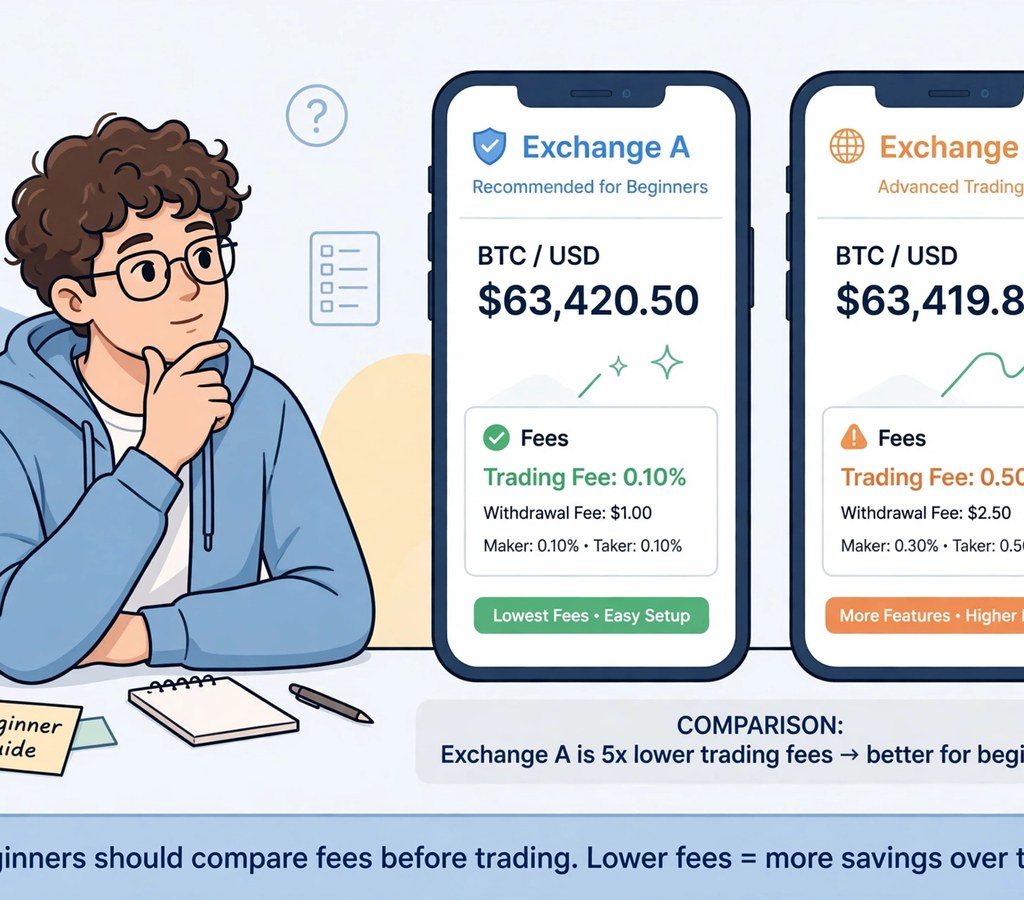
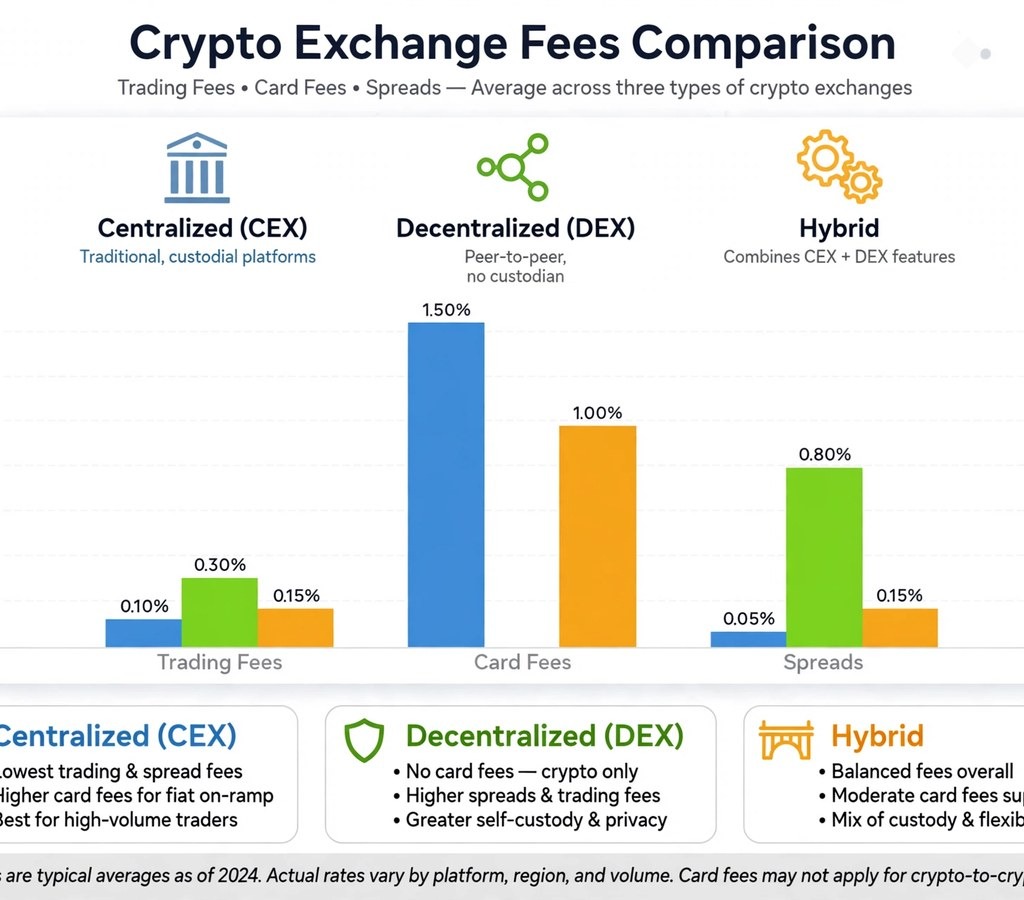
Most exchanges split trading fees into two kinds. A maker fee applies when your order waits in the order book, adding liquidity. A taker fee applies when your order executes immediately against an existing offer. Maker fees are usually lower, which rewards patient traders who use limit orders. Many major exchanges charge somewhere around 0.1% to 0.6% per spot trade on basic tiers, with discounts for high volume or for paying fees in a platform token. Exact numbers differ by platform and tier, so always check the live fee schedule before depositing.
Deposit and Withdrawal Fees
Bank transfers are often free or cheap to deposit, though they can take a day or two. Card purchases are instant but typically carry the highest charges, often a few percent once card processing and platform fees combine. Withdrawals of crypto cost a network-related fee that varies by coin and congestion. Withdrawing cash to your bank is usually cheap, but some platforms add a flat charge.
The Hidden Costs: Spreads and Conversions
The spread is the gap between the price you buy at and the price you could immediately sell at. Instant-buy features often bake a spread of around 1% or more into the quoted price, though it varies with market conditions. Currency conversions add another layer: buying a coin priced in dollars with euros in your account triggers a conversion rate you did not choose. Buying stablecoins first and trading from them can reduce these surprises, a trick covered in stablecoins explained.
| Fee Type | What It Is | Typical Range | How to Pay Less |
|---|---|---|---|
| Spot trading fee (taker) | Charged when your order executes immediately | Often around 0.1%–0.6% on major platforms | Use the advanced/pro trading screen instead of instant buy |
| Spot trading fee (maker) | Charged when your limit order rests in the book | Usually lower than taker; sometimes near 0.1% or less | Place limit orders and let the market come to you |
| Card / instant buy | Buying instantly with a debit or credit card | Commonly a few percent all-in, plus spread | Deposit by bank transfer and trade manually |
| Crypto withdrawal | Moving coins off the platform to your wallet | Varies by coin and network congestion | Withdraw less often, in planned amounts; compare networks |
| Spread | Gap between buy and sell quotes on simple buy screens | Can be around 1% or more on instant features | Check the real market price on the trading screen first |
A useful habit: before any sizable trade, run the same order through two platforms and compare the final amount of coin you receive. The difference is your true cost, and it takes two minutes to check. Fees also interact with taxes in many countries, so keep records; our primer on crypto tax basics guide explains what to save.
Security Checks Before You Trust Any Crypto Exchange
An exchange can be cheap and slick and still be a bad home for your money. Run these checks before you deposit anything meaningful. They take fifteen minutes and they filter out most of the danger.
Check Regulation and Licensing First
Reputable exchanges register with financial authorities in the countries where they operate and publish those licences. Regulation does not guarantee safety, but unregulated platforms answer to nobody when things go wrong. Our reporting on CFTC crypto oversight shows how actively US regulators now police this industry, and the Japan crypto regulation update shows how stricter licensing protected users there. Prefer platforms that operate openly under rules like these.
Look for Proof of Reserves and Transparency
After past industry collapses, serious exchanges began publishing proof of reserves: cryptographic evidence that customer assets exist. Check whether the platform publishes reserve reports, names its auditors, and maintains a public status page. Silence on all three is a warning sign.
Test the Account Security Features
- Two-factor authentication (2FA) with an authenticator app, not just SMS codes.
- Withdrawal allowlists, so coins can only leave to wallet addresses you approved in advance.
- Anti-phishing codes in official emails, so you can spot fakes.
- Login alerts and device management, so you see new sign-ins immediately.
- A clear incident history. One honest, well-handled breach years ago is less worrying than a pattern of denials.
Cold Storage vs Hot Wallets
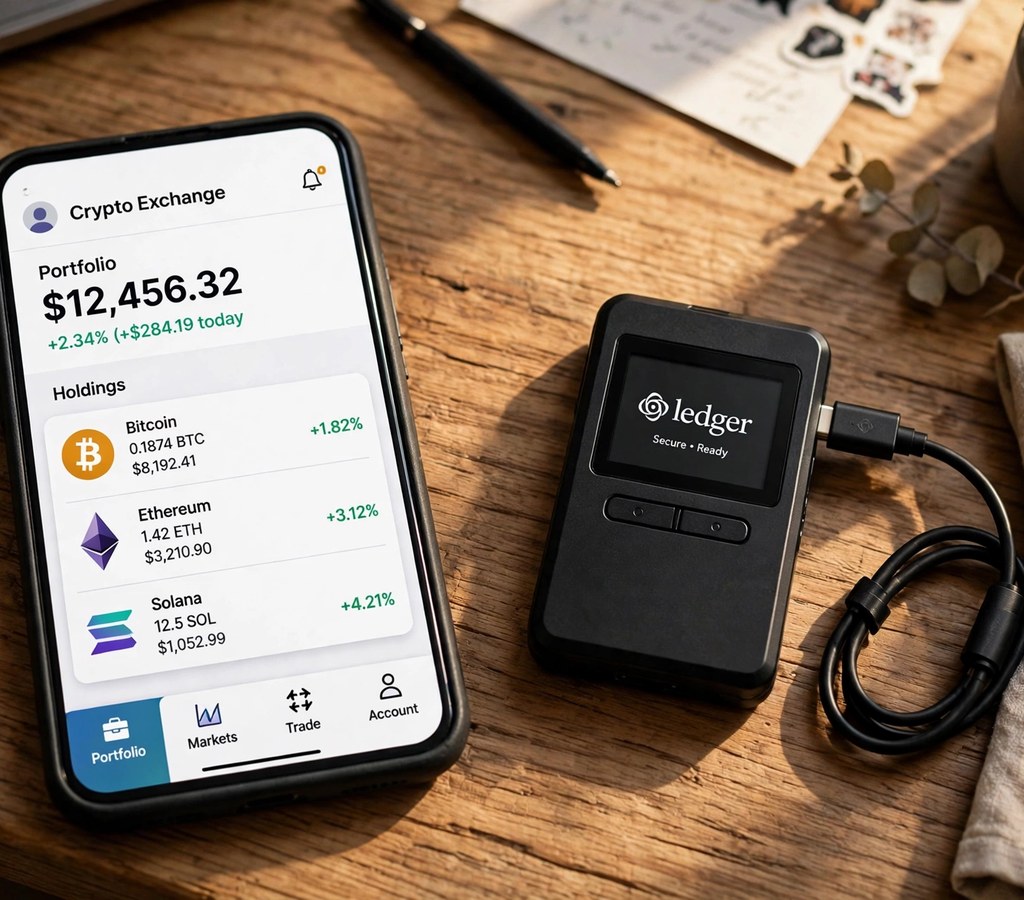
Good exchanges keep most customer funds in cold storage: wallets disconnected from the internet. Only a small working float sits in online “hot” wallets for daily withdrawals. Platforms rarely publish exact percentages, but a stated cold-storage policy is a basic sign of professionalism. For your own long-term holdings, self-custody goes further still; see how to store crypto in a hardware wallet and the wallet guides at Ethereum.org.
The US Federal Trade Commission also maintains a plain-language guide to cryptocurrency scams. Read it once; the patterns repeat everywhere.
KYC Explained: Why Exchanges Ask for Your ID
KYC, short for “Know Your Customer,” is the identity check most centralized exchanges require. You typically upload a government ID and take a selfie. Platforms do this because anti-money-laundering laws require them to know who is moving money through their systems.
Verification usually unlocks higher deposit and withdrawal limits and full access to bank transfers. Some platforms allow small, limited accounts with only an email address, but limits are low and features are restricted. Decentralized exchanges skip KYC entirely because no company takes custody of your funds.
Practical advice: complete KYC before you need to trade urgently. Verification can take minutes, but during market chaos or document problems it can stretch to days. Keep your ID scans ready, use your legal name exactly as printed, and never pay a third party to “verify” an account for you. That service is a scam, full stop.
How to Open a Crypto Exchange Account: Step by Step
Opening an account on a reputable crypto exchange takes about fifteen minutes when you prepare properly. Follow these steps in order.
- Shortlist two or three platforms. Use the security checks above and the reviews in the next section. Never sign up through a link sent by a stranger.
- Type the official address yourself. Fake exchange sites copy real ones almost perfectly. Bookmark the real site once you are sure of it.
- Create the account with a unique password. Use a password manager. Never reuse your email password.
- Turn on two-factor authentication immediately. Do this before depositing a single cent, not after your first trade.
- Complete KYC verification. Upload a clear photo of your ID and follow the selfie instructions in good light.
- Make a small test deposit. Send a small amount by bank transfer first. Confirm it arrives before sending more.
- Place a tiny test trade. Buy a small amount using a limit order on the trading screen, so you learn the interface cheaply.
- Do a test withdrawal. Move a small amount to your own wallet to prove the route works, then whitelist that wallet address. If you are new to wallets, review bitcoin security basics before moving larger sums.
After your first successful cycle of deposit, trade, and withdrawal, the platform stops feeling mysterious. From there, scale slowly. Most expensive lessons in crypto come from rushing step sizes, not from choosing the “wrong” reputable platform.
10 Crypto Exchanges and Tools Reviewed
No single platform wins every category. The honest answer to “which is the best crypto exchange?” is: it depends on your country, your coins, and how you trade. Here are ten widely used options and tools, with balanced assessments. Fees change over time, so treat the pricing notes as a starting point and confirm current schedules on each site.
1. Binance
Pros: Deep liquidity, huge coin selection, low base trading fees, strong mobile app. Cons: The interface overwhelms beginners; availability and features vary by country; regulatory status differs across regions. Pricing: Tiered maker/taker spot fees, with base levels commonly around 0.1% and discounts for volume. Best use: Active traders who want many markets in one place.
2. Coinbase
Pros: Very beginner-friendly, strong regulatory footprint in the US, clean design, educational content. Cons: Simple-buy fees and spreads are high; the cheaper advanced trading screen must be chosen deliberately. Pricing: Instant buys cost noticeably more; the advanced trade interface uses lower tiered maker/taker fees. Best use: First-time buyers in supported countries who value simplicity and compliance.
3. Kraken
Pros: Long operating history, respected security culture, transparent communications, good bank-transfer support. Cons: Interface feels dated to some users; instant-buy route costs more than its pro screen. Pricing: The Kraken Pro fee schedule is tiered by 30-day volume and is competitive at higher tiers. Best use: Users who prioritize a careful, security-first centralized platform.
4. Bybit
Pros: Fast trading engine, popular derivatives markets, frequent promotions, polished app. Cons: Not available everywhere; derivatives carry serious risk and are unsuitable for most beginners. Pricing: Tiered maker/taker fees, broadly in line with other large platforms. Best use: Experienced traders in supported regions who understand leveraged products.
5. OKX
Pros: Broad product range, integrated wallet features, competitive fees, regular proof-of-reserves reporting. Cons: Product depth can confuse newcomers; regional restrictions apply. Pricing: Tiered spot and derivatives fees with volume discounts. Best use: Intermediate users who want exchange and Web3 tools together.
6. Bitget
Pros: Popular copy-trading features, wide altcoin listings, active promotions. Cons: Copy trading can encourage blind following; availability varies by country. Pricing: Tiered maker/taker spot fees, generally around the levels of comparable mid-size platforms. Best use: Users interested in social and copy-trading features, used cautiously.
7. Uniswap
Pros: The best-known decentralized exchange; swap directly from your wallet; enormous token range on Ethereum and other networks. Cons: You pay network gas fees; no support desk; scam tokens exist, so contract addresses must be checked. Pricing: A protocol fee per swap pool plus blockchain gas; no account charges. Best use: Confident wallet users who want self-custody trading.
8. 1inch
Pros: Aggregates many DEXs to find better swap prices; helpful for larger swaps. Cons: Still requires wallet skills and gas fees; interface assumes some DeFi knowledge. Pricing: No platform fee on standard swaps in many cases; you pay gas and the underlying pool fees. Best use: DeFi users comparing prices across venues in one click.
9. MetaMask
Pros: The most widely used self-custody wallet; built-in swaps compare quotes; connects to nearly every DEX. Cons: Swap service adds its own fee on top of quotes; beginners must learn seed-phrase safety. Pricing: A service fee applies to its swap feature; holding and sending costs network gas only. Best use: Your gateway wallet for decentralized trading and storage.
10. CoinGecko
Pros: Free market data across thousands of coins and hundreds of exchanges; handy for comparing prices and checking where a coin trades. Cons: It is a data tool, not an exchange; you cannot trade there. Pricing: Free for standard use, with paid plans for heavier data needs. Best use: Research before you trade: verify prices, volumes, and official links.
Case Studies: Four Scenarios That Teach the Core Lessons
The following case studies are illustrative scenarios built from the most common situations beginners describe. They are teaching examples, not reports about specific real people, and the numbers are kept deliberately simple.
Case Study 1: The Card-Fee Surprise
Problem: A first-time buyer purchased crypto weekly with a debit card through an instant-buy screen. Comfortable and fast, but the all-in cost of each purchase ran to several percent once card charges and spread were combined.
Strategy: Switch funding to bank transfers and place limit orders on the platform’s trading screen instead of instant buy.
Execution: The buyer deposited monthly by transfer, waited for settlement, and set limit orders near the market price.
Results: In this scenario, the effective cost per purchase fell from several percent to well under one percent, keeping noticeably more coin from the same budget.
Lessons: Convenience is a product, and it is priced. The trading screen is where the real market lives.
Case Study 2: The Frozen Withdrawal Panic
Problem: A user kept an entire crypto savings balance on one exchange. During a routine compliance review, withdrawals were paused while extra documents were requested, and the user could not access funds for days.
Strategy: Complete verification proactively, keep documents updated, and move long-term holdings to a personal wallet.
Execution: After access was restored, the user withdrew savings in stages to a hardware wallet, kept a small trading balance on the exchange, and enabled the withdrawal allowlist.
Results: In this scenario, the user’s savings became independent of any single company’s review queue, while day-to-day trading stayed convenient.
Lessons: An exchange balance is a convenience, not a vault. Self-custody removes counterparty risk; learn bitcoin security basics before you need it.
Case Study 3: The Unregulated Platform Trap
Problem: A trader chased a rare token listed only on an unknown offshore platform advertising zero fees. Deposits worked instantly. Withdrawals required a surprise “release fee.”
Strategy: Stop sending money, document everything, and research how the platform was regulated and reviewed before acting further.
Execution: The trader refused the extra payment, since legitimate exchanges never charge a fee to release your own withdrawal, and reported the site through official channels.
Results: In this scenario, the deposited funds were not recovered, but no further money was lost to escalating fake fees.
Lessons: Zero fees plus no licence plus withdrawal “release fees” is a classic fraud pattern. If a platform is not in our regulation coverage or any regulator’s register, treat it as guilty until proven innocent.
Case Study 4: The Two-Platform Shopper
Problem: A regular buyer assumed all big exchanges charged the same and never compared final amounts received.
Strategy: Before each monthly purchase, simulate the identical order on two platforms and compare the exact amount of coin delivered.
Execution: The buyer kept accounts on two reputable exchanges, checked both quotes including withdrawal fees, and bought wherever the total was better that day.
Results: In this scenario, the cheaper venue changed from month to month, and the habit of comparing saved a meaningful slice of every purchase.
Lessons: Loyalty is expensive in markets. Platforms compete; let them. For planning longer-term moves, pair this habit with crypto trading strategies for beginners.
Common Mistakes to Avoid
- Choosing an exchange from an advert or a stranger’s link. Always navigate to the official site yourself.
- Buying through instant buy without checking the spread. Compare against the trading screen price.
- Skipping 2FA until later. “Later” is exactly when accounts get drained.
- Keeping your entire balance on one platform. Spread risk and self-custody long-term holdings.
- Ignoring the withdrawal fee before buying an obscure coin. Some networks cost more to exit than the position is worth.
- Sending a large first transfer. Always test with a small amount on the correct network.
- Trading on margin or derivatives as a beginner. Leverage multiplies mistakes before it multiplies skill.
- Falling for support impostors. Real support never asks for your password, seed phrase, or a “verification payment.”
Expert Tips for Choosing and Using an Exchange
- Start with the exit: Before depositing, confirm you can withdraw both crypto and cash to a bank in your country.
- Read the fee page like a contract: Trading, deposit, withdrawal, and conversion costs all matter; the headline rate is marketing.
- Use limit orders by default: They set your price, often earn the maker fee, and prevent panic taps.
- Turn on every security toggle on day one: 2FA, allowlists, anti-phishing code, and login alerts cost five minutes total.
- Keep a simple trade log: Date, amount, fees, and reason. It sharpens decisions and simplifies tax reporting later.
- Watch how a platform behaves in a storm: Clear status updates during volatility signal a professional operation. Our Bitcoin market pullback coverage shows how quickly conditions can change.
- Learn the charts basics before sizing up: A little how to read crypto charts knowledge prevents expensive misunderstandings of price action.
Troubleshooting: When Something Goes Wrong
Withdrawal Stuck or Pending
First, check the platform’s status page and your email for a compliance review request; document checks are the most common cause. Second, confirm the withdrawal shows a transaction ID on the blockchain. If it does, the delay is network congestion, not the exchange. If hours pass with no transaction ID and no explanation, open a support ticket with the exact time, coin, network, and amount.
Account Locked or Flagged
Locks usually follow a new device, a VPN location jump, or a review trigger. Do not create a second account; that often worsens the flag. Use the official recovery flow, provide the requested documents once, and keep copies of every submission. Never pay anyone who promises to “unlock” accounts for a fee.
Sent Crypto to the Wrong Network
Many coins exist on several networks, and choosing the wrong one is a classic error. If the receiving platform supports that network, support may recover the funds, sometimes for a fee. If you sent to your own wallet, recovery depends on whether the wallet supports the network used. Prevention beats rescue: match the network on both sides, and always send a small test first.
Crypto Exchange Trends and the Future Outlook
Several trends are reshaping how exchanges compete. Regulation is tightening in major markets, pushing platforms toward licences, audits, and published reserves; our guide to evaluating high-growth crypto opportunities explains why that backdrop matters before chasing returns. Proof-of-reserves reporting is becoming a standard expectation rather than a bonus.
Technology is shifting too. Decentralized exchanges keep improving their interfaces, and aggregators blur the line between the two worlds. Account-abstraction wallets aim to make self-custody feel as simple as an app login. Meanwhile, market news moves faster than ever, which is why habits like those in our guide to smarter daily crypto news reading matter as much as platform choice. Events like what is bitcoin halving also drive waves of new users to exchanges, and platforms that handle those surges without freezing withdrawals earn lasting trust.
Expect competition to keep squeezing headline fees while profits move to spreads, premium features, and services. The winning platforms will be the ones that prove their reserves, communicate clearly in crises, and make self-custody easy rather than feared.
A quick note: this guide is education, not financial advice. Crypto assets are volatile and can lose value quickly. Never trade money you cannot afford to lose, and consider speaking to a qualified financial adviser about your own situation.
Frequently Asked Questions
What is a crypto exchange in simple words?
A crypto exchange is a website or app where people buy and sell digital currencies. It matches your order with another user’s order, executes the trade, and charges a small fee. You can deposit bank money, buy coins like Bitcoin, and withdraw them to your own wallet.
Is it safe to keep my crypto on an exchange?
It is safer on a large, regulated platform than on an unknown one, but no exchange is risk-free. Companies can be hacked, freeze withdrawals, or fail. Most experienced users keep only their active trading balance on an exchange and store long-term holdings in a personal wallet they control.
What is the difference between a centralized and a decentralized exchange?
A centralized exchange is run by a company that holds your funds and requires an account and ID checks. A decentralized exchange runs on smart contracts, so you trade directly from your own wallet with no account. Centralized platforms are easier; decentralized ones give you full custody and full responsibility.
How much are crypto exchange fees, usually?
Spot trading fees on many major platforms commonly fall somewhere around 0.1% to 0.6% per trade on basic tiers, with lower maker fees for limit orders. Instant card purchases usually cost several percent once card charges and the spread are included. Always check the platform’s current fee schedule.
Do I need ID to use a crypto exchange?
On most centralized exchanges, yes. KYC verification with a government ID is normally required for bank deposits and full withdrawal limits. Decentralized exchanges do not ask for ID because no company holds your funds, but you need your own wallet and must pay network fees.
How much money do I need to start?
Very little. Many platforms accept deposits equivalent to a few dollars or euros, and you can buy a fraction of a Bitcoin. Starting small is wise: use your first deposits to learn deposits, orders, and withdrawals before committing serious money.
Can I buy crypto with a bank transfer or a debit card?
Yes, most centralized exchanges accept both. Bank transfers are usually the cheapest route but can take one or two days to settle. Cards are instant but typically carry the highest combined fees. Many users deposit by transfer, then trade on the platform’s trading screen.
Which crypto exchange is best for beginners?
There is no single best choice for everyone. Beginners generally do well with a large, regulated platform that supports their country, offers bank deposits, and has a simple interface plus a cheaper advanced screen for later. Compare total costs, security features, and withdrawal options before deciding.
What happens if a crypto exchange shuts down?
If a platform fails, customers may wait months or years in legal proceedings, and recovery is never guaranteed. This is the strongest argument for self-custody. Keep exchange balances modest, enable withdrawal allowlists, and move savings to a wallet where you control the keys.
How do I move crypto from an exchange to my own wallet?
Open your wallet and copy its receive address for the exact coin and network. On the exchange, choose Withdraw, paste the address, select the same network, and enter the amount. Send a small test first. Once it arrives safely, move the rest and consider whitelisting the address.
Conclusion
Choosing a crypto exchange is not a branding decision; it is a financial safety decision. You now know how exchanges work, where the fees hide, which security signals matter, and how to open an account without the classic beginner losses. Start with a regulated platform, complete KYC early, secure the account on day one, and practice with small amounts until every step feels routine. Then move long-term holdings into your own custody and let the exchange do the one job it is best at: giving you fair, liquid access to the market.
Your next steps are simple. Shortlist two platforms today. Run the security checklist on both. Open one account, make a test deposit, and complete a small trade and withdrawal. Bookmark Cryptoorbitzone and keep learning with our market and regulation coverage as you grow.
The platforms will keep evolving: fees will keep falling, regulation will keep tightening, and self-custody will keep getting easier. The users who thrive will be the ones who built careful habits early. So here is the question worth sitting with: if your exchange vanished tomorrow morning, exactly how much of your crypto would still be yours?